Vietnamese Banh Mi: From French Baguette to National Icon
Understand banh mi as living food history — French baguette roots, Vietnamese reinvention, Hanoi fillings and where a sandwich fits between pho, coffee and Old Quarter walks.
By Shaw15 min readHanoi, Vietnam

Introduction — answer first
Travellers search "Hanoi banh mi — best sandwich and French history" wanting three answers: what distinguishes Hanoi banh mi, where to buy without a stale tourist trap, and how French colonial bread became Vietnam's favourite street food. Eat banh mi for breakfast or late morning from a vendor whose bread still steams when cut — northern versions are simpler and less sauced than southern mega-sandwiches, and that restraint is intentional. See also our complete guide to visiting Hanoi.
Shaw tracks food clocks; Paul, our heritage editor, tracks colonial food layers — banh mi sits at their intersection. The sandwich is not "French food in Vietnam"; it is Vietnamese adaptation: lighter crumb, local charcuterie, herb discipline, pickle brightness. This guide covers baguette evolution, Hanoi filling vocabulary, where to buy honestly, colonial context via French influences in Hanoi, comparison with southern styles, and pairing with street food culture and food tours.
From French baguette to Vietnamese icon
Colonial introduction
French administrators and settlers brought wheat bread, pâté, butter, and cold cuts to Indochina in the late nineteenth century. Wheat flour was expensive; early consumption skewed colonial and urban elite. Hanoi, as the northern capital, absorbed bakery culture through French Quarter institutions explored in French influences in Hanoi — cafés, boulangeries, and household staff who learned techniques.
Vietnamese bakers adapted the loaf
Heat and humidity demanded change. Vietnamese bakers developed lighter, airier crumb with thin shatter crust — shorter loaves, faster bake cycles, rice flour blends at some bakeries. The result cracks when squeezed but does not tear the roof of your mouth like dense Parisian baguette.
Fillings localised the sandwich
Pâté remained; cha lua (Vietnamese pork sausage), thit nuong (grilled pork), trung op la (fried egg), pickled carrot and daikon, cucumber, coriander, chilli, and maggi/soy touches joined the split loaf. Price dropped; portability rose. Banh mi — literally "bread" — became the name for the filled sandwich, not just the loaf.
National icon status
By mid-twentieth century, banh mi was student breakfast, worker lunch, traveller snack. Post-war diaspora spread it globally; domestic street culture kept iterating. Today it symbolises practical Vietnamese modernity — one hand eating, scooter parked, no table required.
What Hanoi banh mi looks and tastes like
Bread first
Quality banh mi starts with bread — warm loaf, audible crack, interior steam. Stale bread makes stale sandwich; no filling rescues it.
Filling philosophy — northern restraint
Hanoi vendors often underfill compared with Saigon — fewer proteins stacked, less mayonnaise flood, herbs present but not jungle. Flavours: savoury pâté depth, pickle acid, herb cool, chilli optional.
Common Hanoi variants
| Name | What it is | Who it suits |
|---|---|---|
| Banh mi pate | Pâté + cold cuts baseline | First-timer default |
| Banh mi thit nuong | Grilled pork | Smoky preference |
| Banh mi trung | Fried egg | Vegetarian-adjacent, still often pâté |
| Banh mi xiu mai | Meatballs in tomato sauce | Messier, saucier |
| Banh mi cha ca | Fried fish patty | Alternate protein |
| Banh mi chay | Vegetarian | Rare; verify filling |
Hanoi vs Saigon banh mi — comparison table
| Element | Hanoi | Saigon / south |
|---|---|---|
| Loaf | Shorter, lighter | Often longer, more crumb options |
| Fillings | Simpler, classic | Abundant layers, more sauces |
| Herbs | Moderate | Often generous |
| Price floor | Lower at street stall | Similar range, more premium shops |
| Meal role | Breakfast dominant | All-day strong |
| Heat | Chilli optional, restrained | Often bolder spice |
| Identity | Understated craft | Instagram maximalism common |
Neither region owns "real banh mi" — both evolved from shared colonial root.
When locals eat banh mi — timing
Peak: 06:30–09:30 — workers, students, market porters. Vendors near Dong Xuan Market and school lanes sell out by mid-morning.
Late morning: 10:00–11:30 — second bake or remaining loaves — still valid.
Afternoon: Select carts; quality drops as bread ages.
Evening: Different food clock — bun cha lunch already passed; night snacks differ.
| Time | Expectation |
|---|---|
| 07:00 | Best bread turnover |
| 09:00 | Still strong near offices |
| 12:00 | Many specialists gone |
| 15:00 | Hunt actively or skip |
| 21:00 | Not banh mi mission |
Pair banh mi OR pho at breakfast — not both full size unless hiking Long Bien.
Where to buy — patterns not prescriptions
Street cart at corner turnover
Cart with visible loaf stack, knife board, condiment trays, queue of locals — strongest signal. Cart moves; location may shift — follow smoke and queue, not pinned map from 2019 blog.
Fixed storefront specialists
Some addresses decades old — morning only, shutters down by noon. Photos of menu on wall; prices handwritten.
Old Quarter lanes
Old Quarter guide — banh mi hides on parallel lanes to main tourist arteries. One block off Hang Bac often beats intersection cart for price-to-quality.
Near markets and schools
Dong Xuan periphery and wholesale edges — early worker breakfast. Authentic rhythm, not curated display.
Tourist trap honesty
Red flags:
- Banh mi sold beside unrelated souvenir tee racks all day
- Pre-wrapped sandwiches sitting hours in sun
- USD menu at loudest intersection
- "Best banh mi" banner without morning queue
Green flags:
- Loaf cut to order when you arrive
- Pâté spread fresh on split
- Vendor refuses sale when bread finished — integrity signal
How to order and eat
- Point at filling on sign or neighbour's sandwich
- "Mot banh mi pate" — safe default
- "Khong ot" if no chilli
- Pay cash — small notes
- Eat within five minutes — bread collapses if walked in humidity
- Bag optional — paper wrap normal; plastic bag if eating on scooter later (locals do; tourists walk)
Customisation
Some vendors ask ot khong (chilli yes/no), them pate (extra pâté), bo maggi (maggi splash). Say yes sparingly — northern balance prefers restraint.
Allergy notes
Contains wheat, pork, soy, fish sauce often in pâté and pickles. Not celiac-safe at street cart. Nut use rare but verify peanut oil at fry stations for egg add-on.
Colonial food history — read with Paul
Banh mi is the editable entry point to French influences in Hanoi:
- Bread and pâté — direct colonial import layer
- Herbs and pickles — Vietnamese flavour correction
- Street portability — post-colonial democratisation
- Café culture adjacent — same morning walk as egg coffee
Paul notes: comparing St Joseph's Cathedral architecture and banh mi breakfast same morning shows Hanoi absorbs and transforms — not copies.
Banh mi in street food culture
From Hanoi street food culture — eating like a local:
- One dish specialists — vendor may sell only banh mi 20 years
- Standing eat normal — no table required
- Price transparency — posted on cart lid
- Meal clock — breakfast, not dinner substitute
- Cluster eating — banh mi then coffee two stalls over
Links to pho guide (sit-down soup breakfast) and bun cha (lunch) complete daily arc.
Food tour vs solo banh mi
| Approach | Value |
|---|---|
| Solo 07:30 purchase | Bread freshness education |
| Street food tour stop | Compare two styles one evening |
| Paul + Shaw crossover walk | Heritage morning + cart — rare private custom |
Evening food tours often include mini banh mi bite — not replacement for dawn full sandwich. Food tours guide sequencing: solo breakfast day one, tour day two evening.
Regional context beyond Hanoi
Central Vietnam (Hoi An, Da Nang) promotes richer banh mi variants — worth travel but do not expect Hanoi to match southern maximalism. International diaspora shops (Paris, Melbourne, Los Angeles) often south-influenced — traveller expecting that in Hanoi may misread northern restraint as "small portion."
Trip integration
| Day | Banh mi role |
|---|---|
| 1 | Quick breakfast if pho wait too long |
| 2 | Compare second vendor filling style |
| 3 | Pre-day trip handheld |
| Market morning | Dong Xuan periphery cart |
Complete guide to visiting Hanoi slots breakfast into wider planning.
Colonial timeline — Paul’s compressed chronology
Understanding banh mi benefits from dated layers — expanded in French influences in Hanoi:
| Period | Food layer |
|---|---|
| 1880s–1910s | French baguette elite consumption; urban bakeries |
| 1920s–1940s | Vietnamese staff adapt recipes; urban middle class access |
| 1950s–1970s | Street cart proliferation; local fillings standardise |
| 1990s–present | Doi Moi street economy; global diaspora explosion |
Paul emphasises transformation not imitation — Vietnamese bakers did not fail to copy France; they optimised for climate and pace. Same narrative applies to egg coffee — colonial trigger, Vietnamese ownership.
St Joseph's Cathedral quarter morning walk → banh mi cart illustrates physical coexistence of Gothic spire and pâté sandwich — one hour heritage arc.
Vendor types — cart, window, and hybrid
| Vendor type | Signal | Best for |
|---|---|---|
| Corner cart | Loaf stack under cloth | Dawn freshness |
| Shop window | Fixed address decades | Repeat visits |
| Market fringe | Worker queue | Authentic price |
| Hybrid café | Banh mi plus egg coffee | One-stop morning |
| Hotel breakfast banh mi | Convenience | Not reference quality |
Hybrid café near Hoan Kiem Lake suits jet lag; second day seek cart-only specialist for comparison.
Fillings deep dive — what goes inside
Pate — Pork liver pâté spread on split — umami base; quality varies sharply.
Cha lua — Vietnamese pork sausage slice — mild, bouncy texture.
Thit nguoi — Cold cuts — hybrid colonial charcuterie layer.
Thit nuong — Charcoal grilled pork — smoky highlight; vendor grills morning batch.
Trung op la — Fried egg — yolk richness; popular 09:00–10:30.
Xiu mai — Meatballs in tomato — messier; saucier northern variant.
Do chua — Pickled carrot and daikon — mandatory acid; ask if missing.
Rau thom — Herb bunch — coriander, cucumber strips.
Custom: "it pate" less pâté if richness overwhelms.
Diaspora banh mi vs Hanoi baseline
Melbourne, Paris, Los Angeles banh mi shops often size up portions and sauce heavily — traveller expecting diaspora scale in Hanoi may feel underfilled. Reverse shock also true: southerners find Hanoi too plain. Calibrate expectations before reviewing stall unfairly.
International fame lists ("best sandwich world") usually reference southern or diaspora styles — Hanoi merit is bread craft and balance, not stack height.
Customs and packing — flying home
Dry banh mi does not travel — eat fresh. Packaged banh mi pate jars or chilli sauce from Dong Xuan Market if gift hunting — declare at home country customs. Fresh herbs in luggage fail quickly — skip.
Morning walk pairings — banh mi routes
Route A — Lake loop: Cart near Hoan Kiem Lake north → eat standing → egg coffee second stop.
Route B — Market dawn: Dong Xuan Market periphery 07:00 → banh mi → market walk one hour — Shaw's food-first market entry.
Route C — French Quarter: French influences architecture walk → banh mi cart on colonial grid edge — Paul's narrative arc.
Each route one sandwich — do not pre-eat hotel pastry heavily.
Vegetarian and dietary banh mi — honest limits
Banh mi chay exists at specialised vendors — not every cart. Fillings: tofu, mushroom, seitan variants; verify fish sauce in marinade. Vegan strict requires explicit Vietnamese confirmation — pâté cross-contact on board common.
Gluten: baguette is wheat — no GF street banh mi default; rice plates elsewhere for celiac travellers.
Price and payment patterns
Stalls post 20–45k on lid — price stable year to year modest inflation. Pay exact cash when possible — vendor appreciates small notes. QR payment emerging at fixed shops; cart often cash only.
Tipping not expected — smile and return tomorrow stronger compliment than coin tip.
Evening banh mi misconception
Night carts selling leftover bread appear near beer zones — different product from dawn bake. After Ta Hien beer street, handheld snack ok; do not judge Hanoi banh mi by midnight bread alone.
Shaw’s first-timer order script — full sequence
07:15 — Leave hotel toward cart with queue forming.
07:22 — Point at patron sandwich if undecided; say "Mot banh mi pate, it ot".
07:23 — Pay cash; step aside from queue lane.
07:24–07:29 — Eat before bread steams soft in hand.
07:35 — Second coffee at coffee culture stall within three blocks — do not sit down full restaurant yet.
07:50 — Old Quarter guide walk begins with fuel — not hangry photography.
Total morning cost under 80,000 VND often — best value meal in trip if bread fresh.
Repeat day three with thit nuong filling to compare smoke profile against pate baseline — two-sandwich education beats one oversized food tour tasting plate.
Local expert insights — Shaw and Paul
Bread temperature beats vendor fame — Warm loaf from anonymous cart beats cold celebrity sandwich.
Pate smell should be clean — Rancid oil ruins banh mi; walk away.
Shorter queue at 07:15 — Ten minutes later doubles at school corners.
Hanoi restraint is not cheapness — Fewer fillings, balanced bite — compare before calling it "less than Saigon."
Egg banh mi mid-morning — Trung vendors peak 09:00–10:30; different cart sometimes.
Maggi drizzle optional — Default vendor pace may skip; ask if you want umami lift.
Photograph cart, not vendor face close-up — Courtesy on busy breakfast shift.
Colonial tour + banh mi — French Quarter guide walk ending at cart ties Paul's narrative to Shaw's bite.
Closing — what to read next
You succeeded if day two breakfast you ordered mot banh mi thit nuong in Vietnamese fragment and ate standing without map pin.
Read next:
- French influences in Hanoi — colonial layer Paul recommends
- Street food culture — master etiquette
- Pho guide — alternate breakfast
- Coffee culture — morning pair
- Food tours guide — street food tour
Planning: Complete guide to visiting Hanoi · Old Quarter guide
FAQ — quick answers
Question: Is banh mi French or Vietnamese?
Answer: Both in origin, Vietnamese in identity — French baguette and pâté adapted with local fillings, pickles, and herbs into a distinct national sandwich.
Question: What is the best banh mi filling in Hanoi?
Answer: Banh mi pate or thit nuong for first-timers — choose based on pâté depth vs grilled smoke preference.
Question: When should I buy banh mi?
Answer: Early morning, ideally 07:00–09:30, when loaves are freshest — many specialists close by midday.
Question: How is Hanoi banh mi different from Saigon?
Answer: Simpler fillings, shorter loaf, less sauce — northern restraint vs southern abundance; both authentic.
Question: Where should I buy banh mi in Hanoi?
Answer: Morning carts with queues and fresh-cut loaves — Old Quarter side lanes and Dong Xuan Market periphery; avoid all-day tourist carts with pre-wrapped stock.
Question: Does banh mi connect to French colonial history?
Answer: Yes — read French influences in Hanoi for bakery, pâté, and urban food culture context alongside the sandwich.
Question: Should I get banh mi on a food tour?
Answer: Tours often include a small tasting — still eat one full solo breakfast sandwich for freshness lesson; see Hanoi Street Food Tour.
Question: How much does banh mi cost?
Answer: Roughly 20,000–45,000 VND at street stalls in 2026 — premium fillings slightly higher; confirm before ordering.
Local tips
- →Eat the signature dish for Vietnamese Banh Mi when the stall is busy with locals — turnover beats décor.
- →Vietnamese Banh Mi: For Hanoi food crawls, start hungry but not starving; pace stops 20–30 minutes apart.
- →Group Vietnamese Banh Mi with nearby sights in the same Hanoi district to cut cross-town Grab time.
- →Walk to Vietnamese Banh Mi early; Hanoi heat and scooter density rise after 09:30.
Good to know
- Vietnamese Banh Mi prices move; confirm at the counter before you sit if the board is unclear.
- Vietnamese Banh Mi: Morning pho and lunch bun cha windows differ — Hanoi specialists often sell out.
- Near Vietnamese Banh Mi, Hanoi street vendors often need small cash even when hotels take cards.
- Tet and festival weeks change opening patterns for Vietnamese Banh Mi — verify that week’s hours.
Before you go
- Carry small VND notes for Vietnamese Banh Mi; many excellent stalls remain cash-first.
- Vietnamese Banh Mi: If travelling with allergies, learn key ingredient words before you order around Hanoi.
- Screenshot offline maps for the blocks around Vietnamese Banh Mi before you enter dense Hanoi lanes.
Common mistakes
- ✕Buying afternoon banh mi for breakfast nostalgia — Stale bread lesson.
- ✕Expecting southern stack height — Misread northern style.
- ✕Only eating banh mi at tourist intersection — Walk one lane.
- ✕Saving sandwich for hotel two hours later — Collapsed texture guaranteed.
- ✕Skipping pickles — Acid balance essential; ask restore if forgotten.
- ✕Ordering unknown filling with allergy undisclosed — Pâté hides fish sauce.
- ✕One banh mi then "done with street food" — Culture guide lists five meals.
- ✕Paying USD without checking VND price — Small overpay pattern.
- ✕Ignoring coffee pairing — Half the Hanoi morning ritual.
- ✕Comparing only to international fusion banh mi — Reset to local baseline.
Practical information
- How to get there
- Carts and shopfronts across central Hanoi — look for steady local queues and fresh bread turnover.
- Best time to visit
- Mid-morning through afternoon; bread quality drops when stock sits.
- Suggested itinerary
- Pho or coffee morning → banh mi mid-morning → Old Quarter walk → bun cha lunch.
- Nearby attractions
- Old Quarter
- French Quarter
- Coffee shops
- Hoan Kiem Lake
Frequently asked questions
- Is banh mi French or Vietnamese?
- Both in origin, Vietnamese in identity — French baguette and pâté adapted with local fillings, pickles, and herbs into a distinct national sandwich.
- What is the best banh mi filling in Hanoi?
- Banh mi pate or thit nuong for first-timers — choose based on pâté depth vs grilled smoke preference.
- When should I buy banh mi?
- Early morning, ideally 07:00–09:30, when loaves are freshest — many specialists close by midday.
- How is Hanoi banh mi different from Saigon?
- Simpler fillings, shorter loaf, less sauce — northern restraint vs southern abundance; both authentic.
- Where should I buy banh mi in Hanoi?
- Morning carts with queues and fresh-cut loaves — Old Quarter side lanes and Dong Xuan Market periphery; avoid all-day tourist carts with pre-wrapped stock.
- Does banh mi connect to French colonial history?
- Yes — read French influences in Hanoi for bakery, pâté, and urban food culture context alongside the sandwich.
- Should I get banh mi on a food tour?
- Tours often include a small tasting — still eat one full solo breakfast sandwich for freshness lesson; see Hanoi Street Food Tour.
- How much does banh mi cost?
- Roughly 20,000–45,000 VND at street stalls in 2026 — premium fillings slightly higher; confirm before ordering.
From the road
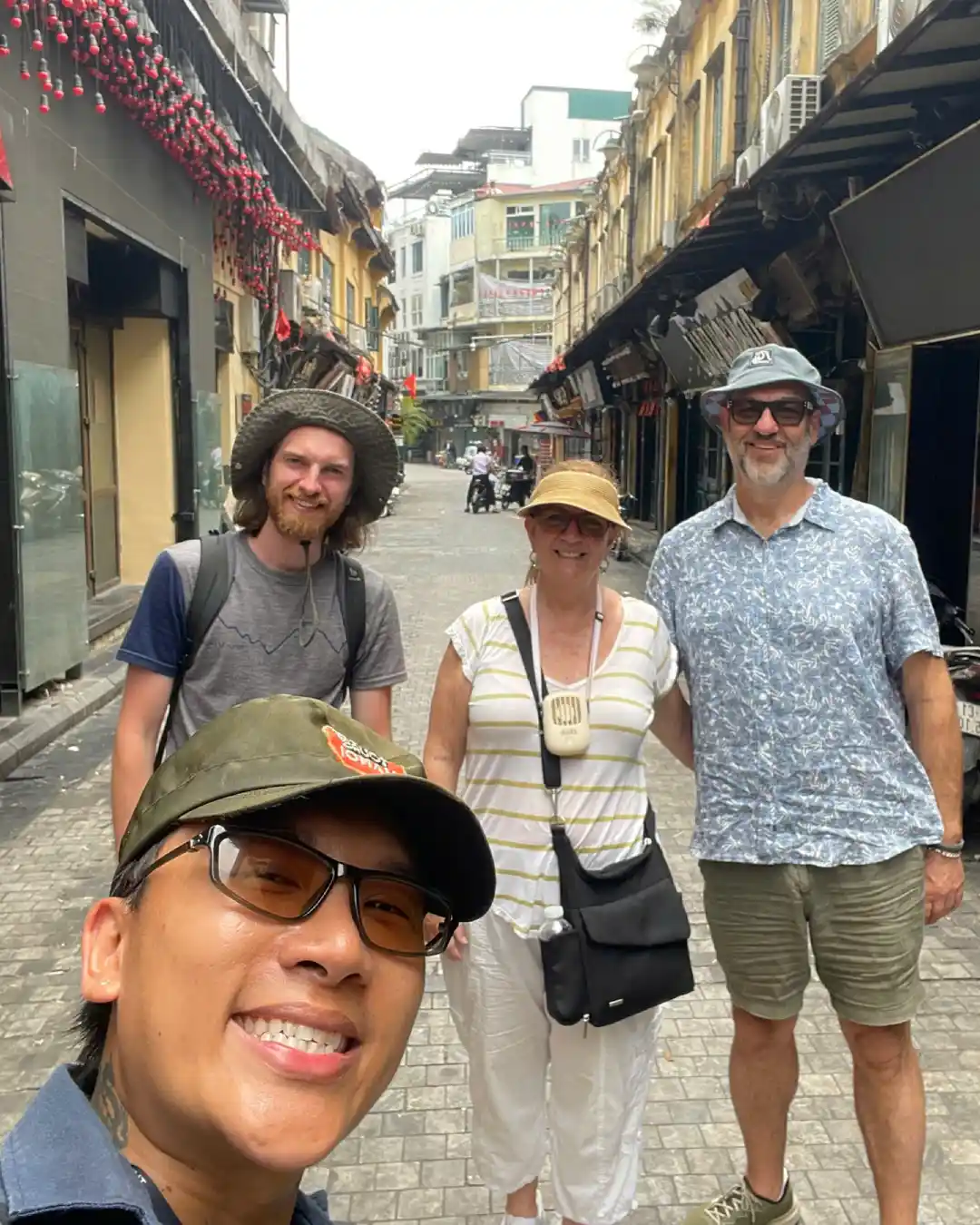
Related real moment
A photo journal from Hanoi — not a traveller review, and not proof that every detail in this guide happened on that walk.
Related content
Destination hub
Hanoi →Related stories
- Hanoi Street Food Culture: Eating Like a LocalEat Hanoi with local timing and judgement — stall heuristics, meal windows, hygiene sense and funnels into pho, bun cha, banh mi and guided food walks.
- Hanoi Pho GuideMaster Hanoi pho — broth style vs Saigon, when locals eat, how to order, condiment etiquette and how to fold a bowl into a wider street-food day.
- Hanoi Bun Cha GuideEat bun cha like a Hanoian — grilled pork, dipping broth, herbs, lunch timing, shop heuristics and how it fits a street-food day without tourist-trap noise.
- Hanoi Egg Coffee Guide: From Sidewalk Cafés to Egg CoffeeUnderstand Hanoi coffee culture — sidewalk stools, robusta drip, egg coffee history, and how to taste like a local without treating every café as a tourist stop.
- Hanoi Food Tours GuideCompare Hanoi food tour formats — evening street food walks, morning market routes and private tastings — with booking timing, allergies and funnel advice from street food culture.
- French Colonial Heritage in Hanoi: Architecture, Food and Everyday LifeHow French Indochina shaped Hanoi's boulevards, baguettes and coffee culture — and where to see that legacy today without confusing history with a walking route.