French Colonial Heritage in Hanoi: Architecture, Food and Everyday Life
How French Indochina shaped Hanoi's boulevards, baguettes and coffee culture — and where to see that legacy today without confusing history with a walking route.
By Paul12 min readHanoi, Vietnam
Introduction — history, not a walking route
Visitors often search "French Quarter Hanoi" and land on two different questions: what colonialism left behind, and how to walk the boulevards today. Those are related but not the same page. Here we focus on period context, architectural types, food legacy and the nuanced cultural memory of French Indochina — the background that makes the Opera House, St Joseph's Cathedral and Trang Tien cafés meaningful. See also our complete guide to visiting Hanoi.
If you want timings, stops and a 2–3 hour self-guided loop, read the Hanoi French Quarter guide. If you want dynasties before the French and independence after, read our history of Thang Long and modern Hanoi. This story sits between them — colonial layer only.
Historical background — from conquest to capital
French military control of northern Vietnam consolidated in the 1880s. Hanoi, already a regional centre under the Nguyen dynasty, was selected as the administrative heart of French Indochina — a federation spanning Vietnam, Cambodia and Laos.
From 1902, accelerated urban planning transformed the area south and east of Hoan Kiem Lake. Colonial engineers laid out boulevards, parks, railway connections and government complexes that contrasted sharply with the organic guild streets of the Old Quarter to the north-west. The goal was visibility, order and European civic identity — not integration with existing Vietnamese neighbourhood logic.
Independence in 1954 did not erase the built fabric. Many structures were repurposed as government offices, embassies, hotels and cultural venues rather than demolished. That continuity is why Hanoi feels like a palimpsest — Vietnamese street life operating inside and around European shells.
Architecture and landmarks — what to recognise
Colonial Hanoi is not one style. You will see Beaux-Arts civic buildings, neo-Gothic churches, Art Deco touches and utilitarian railway engineering — often on the same afternoon walk.
Hanoi Opera House
Completed in 1911 and inspired by the Palais Garnier in Paris, the Opera House remains the district's cultural anchor on Trang Tien. Our Hanoi Opera House guide covers performances, tickets and exterior visiting.
St Joseph's Cathedral
Built in 1886, the neo-Gothic cathedral on Nha Chung introduced a European church typology to the capital and still anchors Catholic community life. The square in front is one of Hanoi's most photographed public spaces — as much social theatre as architecture.
Presidential Palace and Ba Dinh
Originally the Governor-General's residence, the palace exemplifies grand colonial residential scale — though it sits in Ba Dinh, not the lake-side French Quarter. Pair it with the mausoleum and citadel on a separate half-day; our Ba Dinh district day guide coordinates that route.
Long Bien Bridge
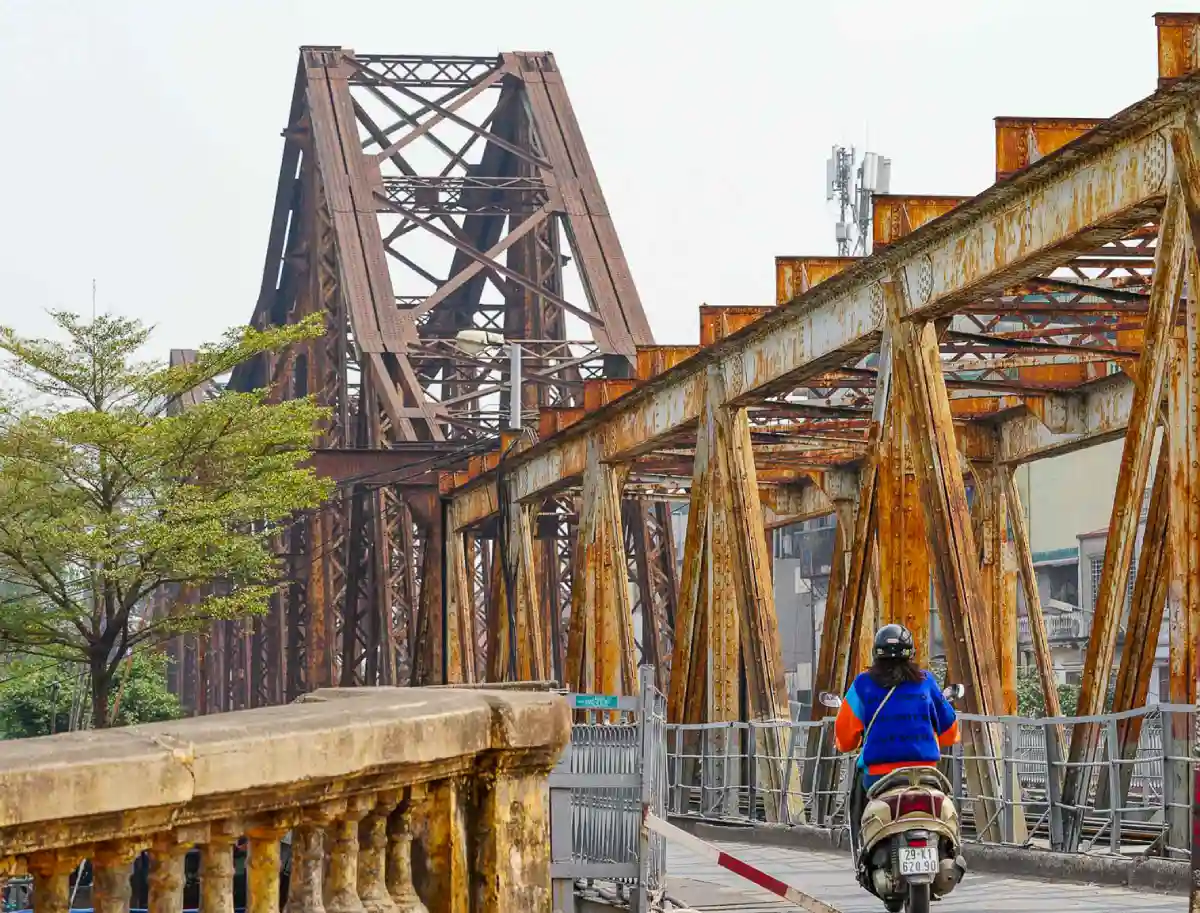
Opened in 1902, the Paul Doumer Bridge (now Long Bien) was an engineering statement connecting the city across the Red River. It still carries trains and pedestrians — a working monument, not a museum piece. See our Long Bien Bridge guide for crossing safely and photography timing.
Villas, post offices and schools
Look for yellow stucco, green shutters, arched windows and deep setbacks on Ly Thai To, Le Thanh Tong and surrounding lanes. Many ground floors are now banks, cafés or retail — the façades survive even when interiors are fully modernised.
Food and coffee — colonial ingredients, Vietnamese invention
French rule did not simply transplant Parisian cuisine. It supplied techniques and ingredients that Vietnamese cooks adapted into something distinct.
The baguette became banh mi — shorter, crisper, filled with pâté, herbs, pickles and local proteins. Our Hanoi banh mi guide traces that evolution from colonial bread to national street-food icon.
Coffee arrived through French plantation culture; Vietnam later became a global producer. Hanoi developed its own rituals — dense drip coffee (ca phe den), condensed milk (ca phe nau) and the city's signature egg coffee (ca phe trung). The Hanoi egg coffee guide covers where and how locals drink it today.
Pastries, butter, pâté and café culture persist in hotel lounges and sidewalk stalls alike — often side by side on the same boulevard block.
Education, urban planning and public life
Colonial administration introduced formal school networks, legal codes and municipal services that overlapped with — and sometimes displaced — existing Confucian education centred on the Temple of Literature. Post-independence Vietnam rebuilt its own systems, but street grids, lake-front promenades and public parks from the era remain in daily use.
Tree-lined shade on Trang Tien, traffic circles and the contrast between wide French boulevards and Old Quarter lanes are planning choices you still navigate on foot. That spatial experience is part of the heritage — not only the monumental buildings.
Cultural legacy — how to think about it as a visitor
French colonial heritage in Vietnam is contested memory — a period of extraction and control as well as architectural and culinary exchange. Most Hanoians today engage colonial buildings as practical city fabric: offices, hotels, churches, theatres and cafés rather than as celebration of empire.
As a visitor, the useful frame is observational: notice layering, repurposing and hybrid life — motorbikes passing opera-house columns, egg coffee sold beside neo-Gothic stone, schoolchildren crossing boulevards laid out for a different century.
Respect active worship at the cathedral, security at government sites and dress norms at any temple you combine with this history on the same trip.
Where to see French colonial heritage today
You can encounter this legacy across the centre — not only in the French Quarter. A sensible sequence for first-timers:
- Read this article for context.
- Walk the French Quarter route for boulevard experience (Opera House → cathedral → lake south shore).
- Cross Long Bien Bridge for engineering heritage and river views.
- Eat and drink — banh mi stall, sidewalk drip coffee, one hotel lounge for contrast.
A French Quarter walking tour adds narrative and crossing confidence on day one; the City Highlights tour links Old and French districts if you prefer a single guided orientation.
Local tips
- →Read history first; walk boulevards second — different pages, same afternoon.
- →Notice repurposed buildings — embassies, hotels, offices in colonial shells.
- →Pair one hotel lounge coffee with one sidewalk stall for contrast.
Good to know
- Colonial memory is complex — observe respectfully at churches and government sites.
- Ba Dinh palace and mausoleum are a separate half-day from lake-side boulevards.
- Entity guides cover Opera House, cathedral and Long Bien in detail.
Before you go
- Before you go: note which sites in French Colonial Heritage in Hanoi need covered shoulders or silence.
- Carry a small notebook if you like linking museum labels back to French Colonial Heritage in Hanoi.
- Screenshot offline maps for the blocks around French Colonial Heritage in Hanoi before you enter dense Hanoi lanes.
Common mistakes
- ✕Searching French Quarter and expecting only one article — route vs history are split.
- ✕Treating colonial architecture as museum pieces — most buildings are working city fabric.
- ✕Skipping food legacy — banh mi and coffee are living colonial inheritances.
Practical information
- How to get there
- Heritage is city-wide — start Trang Tien/Opera House for boulevard layer.
- Best time to visit
- Read before day-one walk; morning light best for photography.
- Suggested itinerary
- Read → French Quarter walk → banh mi + coffee → optional Long Bien.
- Nearby attractions
- French Quarter route
- Opera House
- St Joseph's Cathedral
- Long Bien Bridge
Frequently asked questions
- What is French colonial heritage in Hanoi?
- It is the architectural, culinary and urban-planning legacy of French Indochina (1883–1954) — boulevards, civic buildings, baguette-based street food and café culture still visible in central Hanoi.
- Is this the same as the Hanoi French Quarter guide?
- No. This article explains colonial history and cultural context. The French Quarter guide is a practical walking route with stops, timing and tips.
- Why does Hanoi have French architecture?
- Hanoi served as the capital of French Indochina from 1902, when colonial planners built boulevards, government offices, churches and theatres south and east of Hoan Kiem Lake.
- What Vietnamese foods came from French influence?
- Banh mi evolved from the baguette; coffee culture and many pastry techniques reflect colonial introduction later adapted locally.
- Can I explore French colonial sites on foot?
- Yes — use the French Quarter route guide for a 2–3 hour loop, or join a French Quarter walking tour for guided context on your first day.
From the road
Related real moment
A photo journal from Hanoi — not a traveller review, and not proof that every detail in this guide happened on that walk.
Related content
Knowledge hub
Culture & History →Explore the history, traditions, religions and cultural influences that shaped Hanoi and Vietnam through the centuries.
Destination hub
Hanoi →Related stories
- The History of Thang Long and Modern Hanoi: A Thousand Years of ChangeDiscover the history of Hanoi from the founding of Thang Long in 1010 to the modern capital of Vietnam, including dynasties, colonial heritage and cultural landmarks.
- National Museum of Vietnamese History HanoiPlan the National Museum of Vietnamese History on Trang Tien — dynasty highlights, French-era building, half-day slot and French Quarter pairing.
- Hanoi French Quarter Guide: Boulevards, Opera & Café StreetsWalk Hanoi's French Quarter as a route — Opera House, colonial boulevards, cathedral edge and café streets — distinct from the deeper colonial-heritage culture pillar.
- Hanoi Opera House Guide: Architecture, Shows & NeighbourhoodExplore the Hanoi Opera House — French colonial landmark, when the exterior is enough, how to approach performances honestly, and French Quarter walks that make the visit coherent.
- St Joseph's Cathedral Hanoi: Visit Guide & Heritage ContextVisit St Joseph's Cathedral (Nha Tho Lon) — neo-Gothic twin towers, respectful worship etiquette, Nha Tho café square and how it fits French Quarter and Old Quarter walks.
- Long Bien Bridge Guide: History, Walk & Local LifeWalk Hanoi's working Red River bridge — 1902 French-era steel, wartime scars, Bai Giua gardens and practical safety tips — with Old Quarter and Dong Xuan pairings.