Hanoi Street Names and Their Stories
Decode Hanoi's Hang streets — silk, silver, bamboo and more — with walking lore that turns Old Quarter navigation into living history rather than a map of random names.
By Paul16 min readHanoi, Vietnam

Introduction — answer first
Search intent here is deceptively simple: “What do Hanoi street names mean?” The honest answer: they mean more when you are standing on them. A spreadsheet of Hang-prefixed lanes tells you Hang Bac was silver street. A ten-minute walk on Hang Bac tells you something else — the click of a graver behind a shutter, gold leaf catching afternoon light through a narrow tube-house door, a grandmother crossing with incense from a side alley temple you cannot name yet. See also our complete guide to visiting Hanoi.
Paul, our walking and history editor, opens almost every Old Quarter briefing the same way: treat street names as verbs, not nouns. Hang Ma is not “paper street” on a map; it is the moment you turn a corner in the third lunar month and colour explodes — votive houses, paper motorcycles, currency facsimiles destined for smoke. Hang Gai is not “silk street”; it is touch — cool fabric across your wrist while a tailor measures without speaking English. The names are invitations to notice.
That is why this article is structured as a walk, not a dictionary. We start at the lake rim, move through guild lanes that still reward attention, cross into renamed boulevards where twentieth-century history overwrote commerce labels, and finish with routing tables so your feet match the narrative. For operator choice and tip culture, read free vs paid Hanoi walking tours separately — here we focus on what the names unlock once you are already moving.
The “36 streets” idea — poetry, not spreadsheet
Why guidebooks disagree on the count
You will hear 36 Streets and Guilds in every Old Quarter introduction. The number is symbolic — six times six, auspicious in folk numerology — more than an audited census. Lanes merged, dead-end hem absorbed into wider roads, French planners cut diagonal boulevards through guild blocks, post-war addresses reorganised. Count today and you may reach forty-something; count in a nineteenth-century gazetteer and you get a different set.
Paul’s advice: stop chasing the perfect thirty-six. Chase instead the logic — specialised commerce packed into walkable parallel lanes east of the imperial citadel, each guild paying for its communal house, festival dues and apprentice networks. The history of Thang Long and modern Hanoi explains how that commercial belt grew outside palace walls; this walk shows how it still breathes under motorbike exhaust.
Hang, pho, and what the prefixes whisper
Most guild lanes begin with Hang (goods). You will also see Pho (street, often wider or newer formal routes), Cho (market), Ngo and Nhà Thờ hints near church land. In the Old Quarter core, Hang dominates.
Rough translation cheat sheet — not for memorisation, for pattern recognition:
| Prefix / form | Usual meaning | Walking clue |
|---|---|---|
| Hang + product | Guild merchandise street | Shop types cluster even when trade shifted |
| Pho | Street (often French-era widening) | Wider pavement, colonial facades |
| Cho | Market | Shoulder-height chaos, loading carts |
| Ma May, Ta Hien | Historic lane names (not Hang) | Nightlife or heritage house museums nearby |
When a name no longer matches the shopfront, look up — signboards, guild hall plaques, temple donor lists. The label often outlasts the trade.
A morning walk — lake to silver to silk (90–120 minutes)
This is Paul’s default teaching loop for first-time name learners. It avoids trying to “collect” every Hang in one heat-stunned march.
Step 1: Hoan Kiem rim — orient without GPS worship
Start at the north-east lake corner where Hang Khay meets Dinh Tien Hoang. Stand facing into the Old Quarter, not toward the lake. The grid you are about to enter runs roughly north-west toward Dong Xuan and south toward St Joseph’s spire. The lake is your reset button — if names blur, walk back to water and begin again.
Do not start with Dong Xuan’s roofline — market energy overwhelms before you learn quieter guild rhythm. Save Dong Xuan Market for hour two when you can tolerate sensory volume.
Step 2: Hang Bac — Silver Street that still earns the name
Walk Hang Bac slowly. Bac is silver; historically silversmiths and jewellers dominated. Today you still find goldsmith ateliers — security shutters, magnifying lamps, scales on counters visible when doors open. The street teaches tube-house economics: four metres frontage, workshop behind, family upstairs, motorbike in the gap.
Pause where side alleys smell of solder and citrus peel tea. Paul asks guests to notice sound density — tiny hammers vs mass-market jewellery windows toward the lake end. Silver street did not disappear; it segmented — craft deep in hem, retail gloss facing tourists.
Link forward: Hang Bac intersects Hang Bo and Hang Buom approaches — keep north-ish toward Dong Xuan later.
Step 3: Hang Gai — silk, tailoring, and the name everyone mispronounces
Hang Gai runs parallel logic — gai refers to silk and hemp textiles historically. Modern Hang Gai is tailoring district theatre: mannequins in ao dai, fabric bolts, twenty-four-hour suit promises. Touch fabric when invited; do not photograph measuring tapes without asking.
The lane also hosts diplomatic-facing shops — prices rise toward Hang Bong intersection. Paul sends budget-conscious walkers one block parallel into quieter lanes for coffee before rejoining Hang Gai near the cathedral axis.
Here the walk can fork west toward St Joseph Cathedral — stone verticality after horizontal silk — or stay east toward Ma May heritage houses. Both forks teach naming layers: guild Hang vs French Nha Tho (church) neighbourhood vocabulary.
Step 4: Ma May and the hem lesson
Ma May is not Hang-prefixed but essential — travel and lodging history, now heritage house museums and tour agencies. Duck into a restored merchant house if open; the courtyard explains light wells guild families needed before LED bulbs.
This is where Paul introduces hem etiquette: alleys are homes. Walk single file, no drone fantasies, voice low. Names on corner plaques may list Ngõ numbers — address logic differs from Western odd-even simplicity. Getting lost in a hem is productive if you treat it as residential texture, not trespass.
East-side walk — sails, gates, and paper smoke (second hour)
If morning one taught silver and silk, hour two east teaches river commerce and survival monuments. Route: Hang Buom → Bach Ma → O Quan Chuong → Dong Xuan fringe.
Hang Buom — sail street without sails
Buom means sail. Hang Buom served sailmakers and canvas trades tied to Red River logistics. You will not see many sails today — hardware, hotel lobbies, coffee stalls instead. The name persists like a tattoo after the job changed.
Walk Hang Buom mid-morning and you meet delivery choreography — cartons stacked taller than riders, men shouting weights, bamboo poles flexing. Paul links this to river-to-market supply chains that fed Dong Xuan Market for generations. Stand aside, watch loading, then look up for Bach Ma Temple roof tiles rising above corrugated awnings.
Bach Ma is the White Horse shrine — city foundation legend compressed into a neighbourhood temple still active while scooters whine past the gate. Ten quiet minutes here beat photographing twenty facades. Incense, horse imagery, guardian deity logic — the street name story becomes spiritual infrastructure, not only commerce.
Continue east to O Quan Chuong Gate — last old-city gate arch still in traffic. Stand inside the portal: sound narrows. Stand outside: riverward widening. The gate name honours a commander; the O marks a gate typology. You are now at the eastern bookend Paul uses on Heritage Old Quarter routes.
Circle to Dong Xuan for market upper-floor views if shoulders tolerate crowds — wholesale chaos explains why guild streets needed specialised lanes nearby.
Hang Ma — when the calendar turns the name honest
Hang Ma is the street that most visibly keeps its promise — ma refers to votive paper, ghost money, festival decorations. Ordinary weeks still sell tinsel and party supplies; Ghost Month and Tet seasons turn the lane into saturated colour and smoke.
Walk Hang Ma in late afternoon toward festival weeks and you understand Paul’s “verb not noun” rule. Shops spill goods onto pavement — paper iPhones, paper villas, gold-leafed effigies. Purchasers buy to burn as offerings, transferring merit or remembrance. Photography is sensitive — ask shopkeepers; never mock ritual objects on social captions.
Hang Ma connects north toward Hang Cot and Hang Luoc — smaller lanes with funeral cloth and bamboo ladder trades historically. You do not need every sub-name; you need the insight that death ritual commerce occupied dedicated streets the way silver occupied Hang Bac — practical urban zoning before zoning laws existed.
Pair reading: Buddhism in Hanoi for altar context without flattening folk practice.
Streets that changed costume — Hang Dao, Hang Trong, Ta Hien
Hang Dao — dye street memory
Dao evokes dyed fabrics and textile finishing. Modern Hang Dao mixes cosmetics, fashion, and neon near weekend pedestrian flows. Look for older shop houses with higher ceilings — dye vats needed ventilation; architecture remembers.
Hang Trong — drums and folk painting
Trong (drums) and Trong Quan folk painting traditions cluster in historical sources tied to Hang Trong and nearby lanes. Today you may find frame shops and art replicas more than drum skins. Paul uses Hang Trong to teach sound guilds — cities once organised by noise type: metal on one lane, wood on another, leather on a third.
Ta Hien — the name that forgot its guild
Ta Hien is famous as Beer Street — bia hoi plastic stools, not a Hang prefix. The lane shows how night economy rewrites daytime identity. Names survive while function inverts; walkers who only visit after 21:00 misread the quarter as purely party zone. Walk Ta Hien at 07:00 once — shutters down, mopeds parked, laundry hanging — then return at night for contrast.
When street names stop saying Hang — French Quarter and renamed boulevards
Cross south toward St Joseph Cathedral and Pho Nha Chung / Nha Tho vocabulary replaces guild Hang density. Colonial planners imposed Pho grids — Trang Tien, Ly Thuong Kiet, Dien Bien Phu — honouring heroes, battles, administrators. These names are twentieth-century national narrative, not merchandise.
Paul’s teaching move: stand at cathedral stone, look north toward Old Quarter tube houses, then south toward opera boulevard axis. Same city, two naming regimes — guild product vs commemorative politics. The French influences in Hanoi story covers architecture; this walk covers how labels map power.
Walking across the naming boundary takes fifteen minutes; understanding it saves you from frustrated Googling when Hang disappears from addresses.
Self-guided name walk vs guided heritage tour — comparison
| Factor | Self-guided (this article as script) | Heritage Old Quarter tour |
|---|---|---|
| Name pronunciation | Phonetic guesses; taxi app Vietnamese essential | Guide models tones for Hang Bac, Hang Ma, etc. |
| Guild depth | Read ahead; pause where curious | Live anecdotes, family trade migrations |
| Temple stops | Easy to miss Bach Ma door | Sequenced with etiquette coaching |
| Hem navigation | Higher wrong-turn rate | Guides know which alleys are pass-through vs dead |
| Cost | Free minus coffee | Tour fee; tip on free variants |
| Flexibility | Stop for photos, snacks | Fixed pace; group consensus |
| Best for | Second-day replay after orientation | First 48 hours in Hanoi |
Middle path: Free tour of Hanoi for budget orientation, then independent east-side replay focusing on Hang Buom → gate → market names. For cross-district naming contrast (Old Quarter plus French margins), City highlights walking tour covers ground self-walkers often skip.
Operator comparison and tip norms: free vs paid walking tour guide. Walking philosophy and daily rhythm: Hanoi walking tours.
Practical routing tables — choose your name-learning day
Half-day A — “Guild core” (3–4 hours)
| Block | Route | Name focus |
|---|---|---|
| Hour 1 | Lake north → Hang Bac → Hang Gai → Ma May hem | Silver, silk, merchant house |
| Hour 2 | Hang Dao → Hang Ma → Hang Cot fringe | Dye memory, votive paper |
| Hour 3 | Coffee south → St Joseph exterior → Trang Tien walk | Post-Hang naming |
Half-day B — “East bookend” (3–4 hours)
| Block | Route | Name focus |
|---|---|---|
| Hour 1 | Hang Buom → Bach Ma → O Quan Chuong | Sails, White Horse legend, gate |
| Hour 2 | Dong Xuan → Hang Chieu → back via Hang Bac | Market logistics, silver return |
| Hour 3 | Lake reset + optional Ngoc Son | Compass recovery |
Full-day deep (only if heat and feet allow)
Combine A and B with long lunch — do not add Ba Dinh same day. Name learning is cognitive; mausoleum queues exhaust a different patience reservoir.
Seasonal notes — when names look different
| Season | Street behaviour | Paul’s note |
|---|---|---|
| Tet weeks | Hang Ma peaks; Hang Bac jewellery gift rush | Walk early; shops close unpredictably |
| Ghost Month | Hang Ma smoke and fire drums | Respect ritual burning zones |
| Summer midday | Guild lanes = heat tunnels | Walk 07:00–10:00 or 16:00–19:00 |
| Winter drizzle | Cobble slick; incense stronger in wet air | Best Bach Ma atmosphere |
| Weekend lake closure | Hang Dao / Dinh Tien Hoang pedestrian flow | Names readable without moped dodge |
Local expert insights — what Paul wishes visitors understood
Learn five names deeply, not thirty-six shallowly. Hang Bac, Hang Gai, Hang Ma, Hang Buom, plus one hem you got lost in — that set outlasts checklist anxiety.
Street names are living — shops change faster than signs. A lane called Silver may sell phone cases at street level while silver work continues upstairs. Look for workshop sounds behind shutters.
Guild streets reward parallel walks. Main Hang arteries show retail face; one lane north or south shows residential continuity — same name family, different costume.
Bach Ma is the east-side key. Guests who skip the temple miss how spiritual guardianship sat inside commerce grids, not only on Ba Dinh ceremonial axes.
O Quan Chuong is ten minutes well spent. It anchors wall imagination better than any museum diorama — traffic still passes through history.
Cathedral-to-Old-Quarter transition teaches political naming. Do not treat Hang and Pho as separate cities — they are layers of one capital.
One guided walk, then replay alone at a different hour. Hang Ma at noon vs Hang Ma at dusk are two different streets with the same sign.
Read Old Quarter guide for logistics; this story for lore. Confusing the two produces over-planned marches — use lore to choose attention, logistics to choose toilets.
Common mistakes — street-name edition
- Trying to “complete” all 36 in one afternoon — Heat and motorbike density defeat learning; pick two axes east and west.
- Reading names without entering alleys — Hem depth is where guild families lived; facades alone lie.
- Photographing Hang Ma offerings without context — Sacred commerce is not Instagram prop; ask before close-ups.
- Assuming Hang Bac prices are fixed — Jewellery quotes vary; workshop streets ≠ museum gift shop.
- Skipping Bach Ma because it looks small — Size is not significance; White Horse legend explains urban guardian logic.
- Taxiing between Hang Bac and Hang Ma — Distance is walkable; motorbike breaks narrative thread.
- Visiting Ta Hien only at night — Beer street without dawn walk mis teaches Old Quarter identity.
- Booking three similar tours instead of one heritage walk plus self replay — Duplicate scripts; read free vs paid comparison.
- Ignoring French Quarter rename layer after guild walk — Incomplete story if Hang prefixes are your only lens.
- Standing centre-lane under O Quan Chuong for photos — Traffic chaos; sidewalk angles safer and often better framed.
Closing — let names find you on foot
Hanoi’s street names were never meant for airport reading. They were navigation aids for merchants who already knew the smell of dye, solder, votive smoke and sail cloth — shorthand for where to buy, pray, apprentice and parade. You honour that system not by flash-memorising Vietnamese syllables but by walking slowly enough that labels attach to sensory memory.
Do this: pick Half-day A or B from the tables above; read the Old Quarter guide for practical stops; book one heritage Old Quarter walk if it is your first Hanoi morning; replay alone with this article as script. Stop at Bach Ma. Stand under O Quan Chuong. Touch fabric on Hang Gai. Watch Hang Ma colour if season allows.
You succeeded when a taxi driver says a Hang name and you picture a lane — not a Google result. That picture is the souvenir guild streets still give free to anyone willing to walk them.
Read next: Hanoi Old Quarter guide · Bach Ma Temple · O Quan Chuong Gate · Dong Xuan Market · Hanoi walking tours
FAQ
Why do many Hanoi Old Quarter streets start with “Hang”?
Historically Hang meant goods or merchandise. Streets were named after the primary product sold or crafted there — Hang Bac for silver, Hang Gai for silk, Hang Ma for votive paper. The prefix is a commercial label from the guild era that survived even when trades shifted or moved upstairs behind retail facades.
What are the “36 Streets of Hanoi”?
It is a traditional phrase for the guild street network of the Old Quarter — specialised lanes where craftsmen and merchants organised by trade. Thirty-six is symbolic and approximate; real counts change as alleys merge, rename or disappear under modern road projects. Treat it as a concept for walkable commercial history, not a checklist to complete in one day.
Do Hanoi streets still sell what their names describe?
Some do strongly, especially seasonally — Hang Ma during Tet and Ghost Month, Hang Bac for jewellery, Hang Gai for tailoring. Others keep the name while daily commerce changed: Hang Buom rarely shows sailmakers today, though hardware and river-trade logistics echo the old function. Architecture, side-alley sounds and festival spikes often reveal the original trade better than ground-floor shop windows alone.
What is the best walking route to learn street names?
Paul’s default split is two half-days: (A) lake → Hang Bac → Hang Gai → Ma May → cathedral margin for guild plus rename contrast; (B) Hang Buom → Bach Ma → O Quan Chuong → Dong Xuan for east-side river and gate logic. Each loop takes three to four hours with coffee stops. One guided heritage walk first, then self-guided replay at a different hour, accelerates learning more than any bus tour.
Is Hang Ma appropriate to visit outside festival season?
Yes. Hang Ma sells party goods, decorations and votive items year-round. Peak atmosphere arrives before Tet and during Ghost Month, when paper offerings and smoke intensify. Walk respectfully — these are ritual objects for many shoppers, not props for tourists.
How do street names differ in the French Quarter?
South and west of the Old Quarter core, Pho names honour historical figures, battles and colonial-era planning — Trang Tien, Ly Thuong Kiet, Dien Bien Phu — rather than merchandise. Walking from Hang Bac to St Joseph Cathedral crosses from guild product labels to commemorative and administrative naming in under twenty minutes.
Should I book a walking tour to understand street names?
Not mandatory, but one guided introduction helps pronunciation, hem etiquette and temple stops like Bach Ma. After that, independent walking with a route script — this article or the Old Quarter guide — is ideal. Compare tour types in free vs paid walking tours and Hanoi walking tours.
What is the most common mistake visitors make with Old Quarter street names?
Collecting names like passport stamps — thirty-six in one sweaty afternoon — instead of learning five lanes deeply with alleys, temples and seasonal rhythm. Slow depth beats checklist breadth every time.
Local tips
- →Read Hanoi Street Names and Their Stories before you walk the related district — context changes what you notice in Hanoi.
- →Pair one museum or heritage stop with café time so Hanoi Street Names and Their Stories does not become lecture fatigue.
- →Group Hanoi Street Names and Their Stories with nearby sights in the same Hanoi district to cut cross-town Grab time.
- →Walk to Hanoi Street Names and Their Stories early; Hanoi heat and scooter density rise after 09:30.
Good to know
- Hanoi Street Names and Their Stories spans living culture, not only monuments — markets and meals are part of the evidence.
- Festival timing can reshape access to sites mentioned in Hanoi Street Names and Their Stories.
- Near Hanoi Street Names and Their Stories, Hanoi street vendors often need small cash even when hotels take cards.
- Tet and festival weeks change opening patterns for Hanoi Street Names and Their Stories — verify that week’s hours.
Before you go
- Before you go: note which sites in Hanoi Street Names and Their Stories need covered shoulders or silence.
- Carry a small notebook if you like linking museum labels back to Hanoi Street Names and Their Stories.
- Screenshot offline maps for the blocks around Hanoi Street Names and Their Stories before you enter dense Hanoi lanes.
Common mistakes
- ✕Skimming Hanoi Street Names and Their Stories then expecting a single façade to “explain” Hanoi history.
- ✕Photographing worship or private moments without consent while exploring Hanoi Street Names and Their Stories themes.
- ✕Cramming Hanoi Street Names and Their Stories into a multi-district sprint that ignores Hanoi traffic reality.
- ✕Relying only on hotel concierge timing for Hanoi Street Names and Their Stories without a backup route.
Practical information
- How to get there
- Most Hang streets sit inside the Old Quarter walk shed around Hoan Kiem Lake.
- Best time to visit
- Morning for quieter storytelling walks; evening for atmosphere after shops light up.
- Suggested itinerary
- Guild-street loop → Bach Ma → Dong Xuan façade → coffee → optional Train Street or Beer Street later.
- Nearby attractions
- Bach Ma Temple
- Dong Xuan Market
- Hoan Kiem Lake
- O Quan Chuong Gate
Frequently asked questions
- Why do many streets in Hanoi start with 'Hang'?
- Historically, 'Hang' referred to goods or merchandise. Streets were often named after the products sold there.
- What are the '36 Streets of Hanoi'?
- The term refers to the historic guild streets of the Old Quarter where merchants and craftsmen specialized in particular trades.
- Do streets still sell the products they were originally named after?
- Some do, although many businesses have diversified over time.
- What is the most famous street in Hanoi’s Old Quarter?
- Popular examples include Hang Gai, Hang Ma, Ta Hien, and Hang Bac, each known for different aspects of local culture and commerce.
- How can visitors learn more about Hanoi’s street history?
- Walking tours led by local guides are one of the best ways to understand the stories behind the Old Quarter’s streets and neighborhoods.
From the road
Related real moment
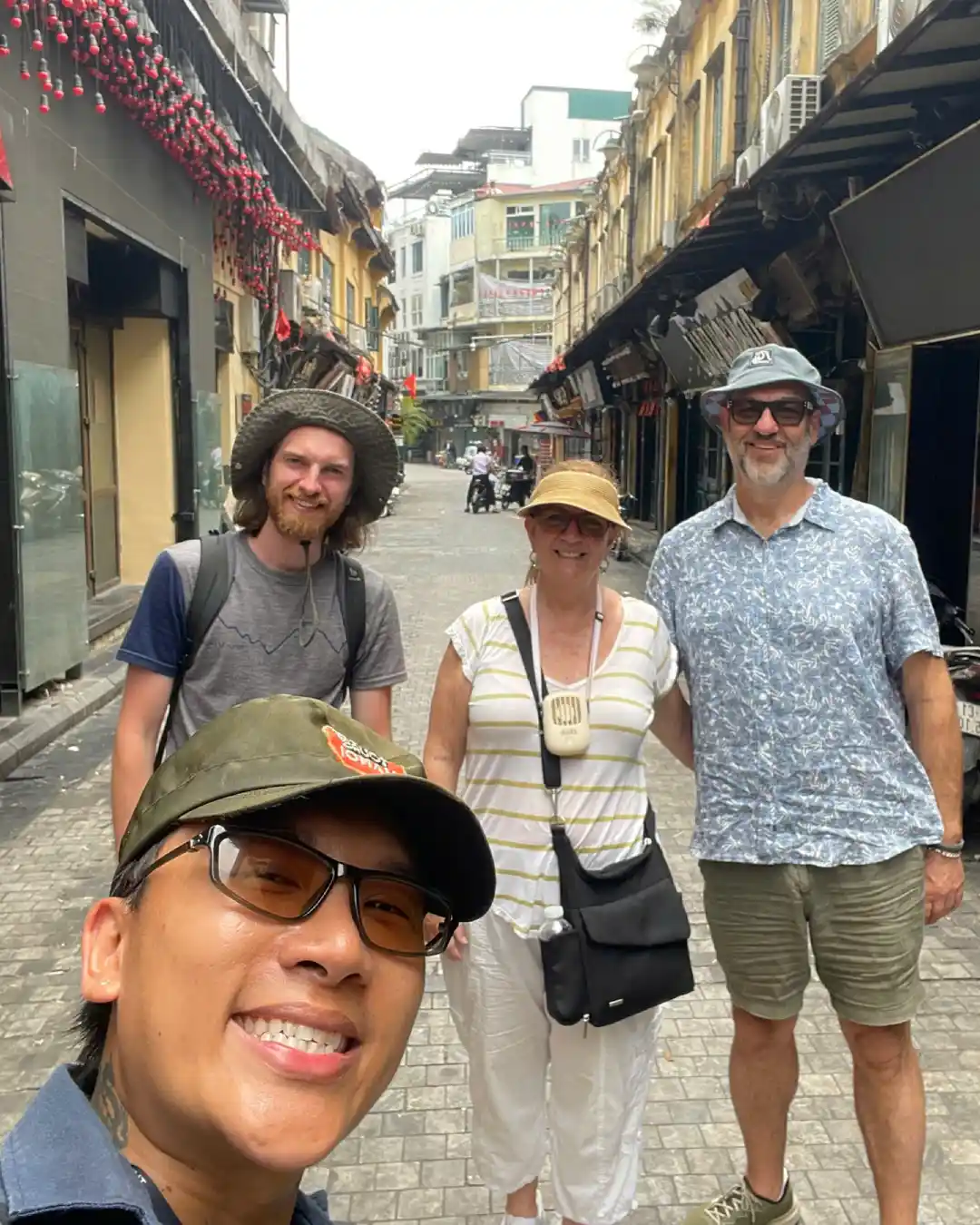
A photo journal from Hanoi — not a traveller review, and not proof that every detail in this guide happened on that walk.
Related content
Knowledge hub
Culture & History →Explore the history, traditions, religions and cultural influences that shaped Hanoi and Vietnam through the centuries.
Destination hub
Hanoi →Related stories
- The History of Thang Long and Modern Hanoi: A Thousand Years of ChangeDiscover the history of Hanoi from the founding of Thang Long in 1010 to the modern capital of Vietnam, including dynasties, colonial heritage and cultural landmarks.
- Hang Ma Street Hanoi: Paper Goods & Festival LaneExplore Hang Ma Street for votive paper, lanterns and Tet shopping — timing, etiquette and how it differs from generic Old Quarter souvenir lanes.
- Hanoi Old Quarter Guide: Streets, Food & Walking LogicNavigate Hanoi's Old Quarter with local walking logic — guild streets, markets, food timing, night energy and how to pair the lake without turning the district into a checklist sprint.
- Bach Ma Temple Guide: Old Quarter's Guardian TempleVisit Bach Ma Temple in Hanoi's Old Quarter — White Horse legend, Hang Buom setting, respectful etiquette and how to weave it into a northern Old Quarter walking loop.
- Dong Xuan Market Guide: Hanoi's Historic Trading HubNavigate Dong Xuan Market like a local — wholesale floors, honest bargaining, nearby food, weekend night market and how to pair it with Long Bien and Old Quarter walks.
- O Quan Chuong Gate: Hanoi's Last Old Quarter GateSee O Quan Chuong — the last remaining gate of Hanoi's Old Quarter — with history context, traffic-aware photo tips and a northern loop linking Dong Xuan, Bach Ma and Long Bien.