O Quan Chuong Gate: Hanoi's Last Old Quarter Gate
See O Quan Chuong — the last remaining gate of Hanoi's Old Quarter — with history context, traffic-aware photo tips and a northern loop linking Dong Xuan, Bach Ma and Long Bien.
By Dinh15 min readO Quan Chuong Street, Hoan Kiem District, Hanoi

Introduction — answer first
Searchers ask "What is O Quan Chuong Gate and is it worth visiting?" Yes — if you understand what it is. O Quan Chuong is not a gated attraction with tickets and exhibits. It is a single arched portal that once controlled entry into the eastern sector of the citadel, named after a military officer associated with its defence. Today it survives while other gates vanished under French urban widening, wartime damage and modern road projects. See also our complete guide to visiting Hanoi.
Paul, our editorial lead on Hanoi urban history, tells first-time visitors: stand on the inside (Old Quarter side) and imagine wall lines extending north and south; stand on the outside and notice how the street widens toward the Red River floodplain. That one step changes sound — narrower echo inside, open air outside. You do not need an hour here. You need correct expectations, safe photo habits, and a walking plan that links the gate to markets, temples and the river without treating it as an isolated selfie pit.
This guide explains the gate's history, how to photograph it without causing traffic chaos, how it fits Thang Long's wall system, and how to build a half-day east Old Quarter route that feels purposeful rather than random.
Historical background — walls, gates and survival
Thang Long's citadel wall system
When Ly Thai To established Thang Long in 1010, defensive walls enclosed a growing urban core. Over centuries the capital expanded, dynasties repaired and relocated wall segments, and French colonial planners cut new boulevards through older fabric. Multiple gates once punctuated the perimeter — names and counts shift in historical sources as wards merged and labels changed.
Understanding O Quan Chuong requires accepting a Hanoi truth: what you see is a surviving fragment, not a restored complete wall walk like Xi'an. The gate's value is authenticity of place — still embedded in daily traffic — rather than monumental scale.
Read history of Thang Long and modern Hanoi for the capital's timeline from imperial seat to modern metropolis; O Quan Chuong becomes clearer when you see how French urbanism and post-war reconstruction removed most wall traces.
Why this gate remained
Several factors helped O Quan Chuong endure when siblings disappeared:
- Neighbourhood attachment — local communities resisted full demolition as streets modernised
- Functional arch — traffic still passed through; removal required effort and dispute
- Scale — single gate arch easier to preserve than entire wall maintenance
- Heritage recognition — later twentieth-century listing as historic monument slowed reckless alteration
The structure you photograph is chiefly nineteenth-century brick and stone repair layered on older foundations — typical for surviving Hanoi monuments.
The name O Quan Chuong
Quan Chuong refers to a gate commander — stories cite Nguyen dynasty officer Quan Chuong associated with defence during French assaults in the late nineteenth century. Naming gates after commanders or directional functions was common. English spelling varies (O Quan Chuong, Ô Quan Chưởng); Vietnamese diacritics help taxi drivers more than Latin approximations.
Do not confuse this gate with Cua Nam or other directional gate names elsewhere in historical records — only O Quan Chuong remains in situ at the Old Quarter edge in popular tourism routes.
What you will see on site
The arch and plaque
A single brick arch spans the street; pedestrians and two-wheeled traffic pass continuously. Plaque text may appear in Vietnamese; English explanation is limited on-site. Height is modest — impressiveness comes from context, not skyscraper scale.
Look for:
- Brick pattern and voussoir stones at the arch crown
- Roof tile cap above the portal — weathered, sometimes mossy in wet season
- Side wall stubs suggesting where thicker wall once extended
- Wear on threshold stones from centuries of foot and wheel traffic
Inside vs outside framing
| Position | Visual story | Suggested shot |
|---|---|---|
| Old Quarter side (inside) | Narrow lane, gate as portal to "old city" | Frame arch with hanging cables and shop signs |
| River side (outside) | Wider street, movement toward dyke | Silhouette scooters passing under arch |
| Oblique angle from sidewalk | Safer than standing in road centre | Morning side light on brick texture |
What is not there
- No ticket booth
- No interior museum room
- No elevator viewpoint
- No guaranteed English guide on site
If you want interpretive depth, bring a guide or read this story before arrival — the gate will not explain itself loudly.
Photo etiquette and traffic safety
The traffic reality
O Quan Chuong sits on a working transport corridor, not a pedestrianised heritage zone. Motorbikes cluster; buses may brush close; delivery drivers honk if you stand in lane centre for "the perfect shot."
Safety rules our guides enforce:
- Feet on sidewalk or curb — never block the arch centre during rush hours (07:30–09:00, 16:30–18:30)
- No stepping backward into traffic while framing — common accident pattern
- Tripods only on quiet edges — lane obstruction irritates locals and risks knock-over
- Drone use — assume restricted without permits; alley wires tangle easily
- Ask before photographing vendors who set stalls near the arch — courtesy prevents conflict
Respectful photography
Heritage photography is welcome; performance photography that blocks worshippers or commuters is not. If a funeral procession or festival column passes, lower camera and step aside — these moments belong to residents, not your portfolio.
Anna, operations editor, notes peak Instagram hours (10:00–12:00 weekends) create clustered posing groups — visit 07:00–08:30 for cleaner frames and cooler air.
Night shots
Artificial light on brick can look atmospheric after dark, but low-light phone noise and traffic blur challenge casual shooters. Tripod users must stay extremely alert — night visibility for drivers is imperfect.
How O Quan Chuong fits an Old Quarter day
East-side half-day route (recommended)
Duration: 3–4 hours on foot
- Hoan Kiem Lake early loop — orientation and coffee
- Walk north/east through Old Quarter lanes toward Hang Buom
- Bach Ma Temple — White Horse legend and neighbourhood altar culture
- Continue east to O Quan Chuong Gate — photos and historical framing
- Dong Xuan Market — produce, textiles, upper-floor viewpoints
- Optional extension: dyke path toward Long Bien Bridge approach for river contrast
This sequence tells one story: spiritual site → wall gate → market commerce → river edge.
Reverse route (afternoon)
Start at Long Bien or dyke sunset, walk west through gate into Old Quarter dinner streets — useful if you prefer golden-hour photos at the arch before Ta Hien evening noise.
Guided alternatives
- Heritage Old Quarter tour — contextualises gate within guild streets and hidden courtyards
- City Highlights Walking Tour — broader capital narrative with Old Quarter segment
Self-guiding works if you have read wall history; guides add anecdotes about vanished gates and French road cuts that maps omit.
Pairing with Long Bien Bridge and Dong Xuan
Long Bien Bridge connection
From O Quan Chuong, walking toward Long Bien Bridge takes 20–35 minutes depending on pace and photo stops along the dyke. The bridge is a separate visit — pedestrian rules, train schedules and safety barriers change; do not assume continuous public walkway without checking current access.
Editorial pairing logic: gate = imperial wall memory; bridge = colonial-industrial river crossing. Same afternoon, different centuries.
Dong Xuan Market proximity
Dong Xuan Market lies a short walk west of the gate — ideal for sensory contrast after quiet brick contemplation. Market mornings beat midday heat; combine gate photos before 09:00, market browsing 09:00–11:00.
Comparison — O Quan Chuong vs other "old Hanoi" landmarks
| Landmark | Type | Time needed | Crowd level | Narrative role |
|---|---|---|---|---|
| O Quan Chuong Gate | Surviving citadel gate | 10–20 min | Medium | Wall system fragment |
| Bach Ma Temple | Neighbourhood temple | 20–40 min | Low–medium | Spiritual urban layer |
| Hoan Kiem Lake | Urban lake + temples | 1–2 hours | High | Civic symbol |
| Thang Long Imperial Citadel | Archaeological site | 1.5–3 hours | Medium | Imperial palace layer |
| Long Bien Bridge | River crossing | 30–90 min | Medium | Modern-industrial Hanoi |
Honest take: Skip O Quan Chuong only if you are severely time-starved and skipping the entire east Old Quarter — otherwise the marginal time cost is low for high narrative payoff.
The vanished wall — imagining what is missing
Mental reconstruction exercise
Stand at O Quan Chuong and trace an imaginary wall line north and south along contemporary streets — most traces gone, but topography hints: lane width changes, sudden corner angles, dyke proximity eastward. French colonial Paul Doumer bridge era (Long Bien predecessor context) and boulevard projects cut through wall fabric — read history of Thang Long and modern Hanoi for nineteenth-century urban surgery.
Paul suggests a three-minute silence exercise: count vehicles passing arch per minute at 08:30 — multiply by centuries of equivalent foot traffic. Gate scale feels human suddenly, not miniature.
Other gate names you may hear
Historical sources reference directional gates — Cua Dong (east), Cua Nam (south), etc. — not all survived photography era. Old postcards and museum dioramas at Thang Long Imperial Citadel help visualise complete enclosure — separate visit, Ba Dinh cluster.
Why wall walks fail as tourism product
Unlike cities preserving continuous wall paths, Hanoi offers fragment appreciation — O Quan Chuong plus citadel archaeology plus oral history. Manage expectations: you will not walk three kilometres on ramparts from this gate alone.
Practical logistics — maps, taxis and meeting points
Address confusion
Search maps for O Quan Chuong Street, Hang Chieu, or gate arch photo pin — drivers understand "O Quan Chuong" Vietnamese pronunciation better than English spelling variants. Show photo of brick arch if language barrier.
Taxi drop-off side
Drop Old Quarter side for standard tourist walk sequence toward Bach Ma and Dong Xuan. Drop river side if starting Long Bien dyke walk westward — less common first-time pattern.
Grab and ride-hail
Pin exact arch — drivers sometimes stop one block short on parallel lane. Walk back rather than circling one-way maze.
Meeting tour groups
Heritage tours often meet cafes near Hoan Kiem first — gate mid-route, not start point. Confirm meeting logistics when booking Heritage Old Quarter or City Highlights.
Extended east-side walking map (half day to full day)
Half day (3–4 hours) — core
Hoan Kiem → Bach Ma → O Quan Chuong → Dong Xuan → lunch Ma May — described earlier.
Full day (6–7 hours) — add river and bridge
Add after lunch:
- Walk dyke direction Long Bien Bridge — check current pedestrian access before promising bridge deck walk
- Coffee warehouse district photo stops — industrial Hanoi contrast
- Return west through Hang Da or Hang Be lanes toward lake sunset
Full day suits photography-heavy travellers; skip if heat above 33°C midday summer — see best time to visit Hanoi.
Evening variant
Gate illuminated inconsistently — do not depend on floodlights. Old Quarter night market energy west of gate beats arch night photography for most casual shooters.
Who will love O Quan Chuong — and who should skip
Strong fit
- Urban history enthusiasts
- Photographers seeking traffic-under-arch motion blur ethical shots from sidewalk
- Walkers building east Old Quarter narrative with Bach Ma Temple
Weak fit
- Travellers needing ticketed attraction with restrooms and gift shop on site
- Mobility-limited without interest in exterior-only view from car window — still OK drive-by
- Single landmark only half-day with no paired stops — underwhelming
Honesty builds trust: gate alone will not fill morning — bundle intentionally.
Seasonal and festival notes
During Tet and mid-autumn weeks, decorations or community events may cluster near the gate — festive colour on brick arches photographs beautifully but increases pedestrian density. Rainy season (May–September) makes brick surfaces slick near the curb; carry a compact shell and wipe phone lenses often — humidity fogs optics.
National holidays with domestic travel surges (30 April–1 May, 2 September) increase scooter volume through the arch — avoid standing in lane centre entirely on those dates.
Local expert insights
Paul (urban history editor): "O Quan Chuong is a survival story, not a reconstruction theme park. Treat the scratches on stone as evidence, not damage to mourn."
Dinh (heritage guide): "I ask guests to name three other gates — they cannot. That gap is the lesson: Hanoi erased most walls. One arch remains; look at it like a sentence fragment from a burned book."
Anna (operations): "Schedule the gate before Dong Xuan crowds peak. Hang Chieu side streets offer coffee resets without tourist beer pricing."
Shaw (culture editor): "Photo seekers forget sound — listen under the arch. You hear the Old Quarter compress. That sensory detail beats another identical frontal shot."
Anna (operations): "Rain turns brick deep red — gorgeous for texture shots. Carry microfiber cloth for lens; humidity fogs optics in minutes. Umbrella in one hand, camera in other — step back from curb."
Closing — what to read next
O Quan Chuong Gate rewards travellers who want one authentic wall fragment still breathing inside modern Hanoi traffic. It is not a half-day site; it is a keystone for east Old Quarter walks linking temples, markets and the Red River edge.
Next reads:
- Hanoi Old Quarter guide
- Bach Ma Temple
- Dong Xuan Market Hanoi
- Long Bien Bridge Hanoi
- History of Thang Long and modern Hanoi
Tours worth pairing:
FAQ — quick answers
Is O Quan Chuong Gate the last old gate in Hanoi? It is the last remaining gate of the old Thang Long citadel wall still standing in its original street setting at the Old Quarter edge — the phrase guides use. Other historical gates exist as names or rebuilt markers elsewhere, but O Quan Chuong is the iconic surviving portal tourists walk through daily.
How much time should I spend here? 10–20 minutes for photos, plaque reading and traffic-aware observation. Longer only if you sketch, film b-roll, or wait for empty-arch moment rare at peak hours.
Is there an entrance fee? No. Public street monument — free anytime.
Best time for photography? 07:00–08:30 for softer light and lower traffic; 16:30–17:30 for warm side light but heavier scooters. Avoid midday harsh contrast unless overcast.
Can you walk through the gate? Yes — the arch is part of the active street; pedestrians and vehicles pass continuously. There is no separate pedestrian-only tunnel.
Is O Quan Chuong safe at night? Generally yes in busy evening hours, but traffic remains dense — stand clear of lane centre; watch bags in crowded market-adjacent evenings.
Do I need a guide? Not required. Guides add wall context and routing — valuable if the gate anchors your historical understanding of Hanoi rather than a quick photo.
What should I visit next? Walk west to Dong Xuan Market or north-west to Bach Ma Temple — both within short walking distance and narratively linked.
Is the gate lit at night? Inconsistently. Some evenings have ambient street light on brick; no guaranteed floodlight show. Plan daytime visit for reliable photography; night visit optional atmosphere only.
Can large tour buses pass through? Small buses and cars sometimes squeeze through; large coaches typically cannot — another reason the gate survived while wider modern vehicles use roads that bypassed demolished wall sections elsewhere.
Does the gate have a ticket counter? No. It is an open street monument — your only costs are optional guided walks, coffee nearby, or transport to reach the Old Quarter east side.
Local tips
- →Arrive at O Quan Chuong Gate at opening or late afternoon — Hanoi midday tour groups peak hard.
- →Pair O Quan Chuong Gate with one nearby stop in the same district, not a city-wide scavenger hunt.
- →Group O Quan Chuong Gate with nearby sights in the same Hanoi district to cut cross-town Grab time.
- →Walk to O Quan Chuong Gate early; Hanoi heat and scooter density rise after 09:30.
Good to know
- O Quan Chuong Gate ticket rules and camera policies can change — verify at the gate, not only in blogs.
- Shade and seating near O Quan Chuong Gate are limited; carry water in warm Hanoi months.
- Near O Quan Chuong Gate, Hanoi street vendors often need small cash even when hotels take cards.
- Tet and festival weeks change opening patterns for O Quan Chuong Gate — verify that week’s hours.
Before you go
- Before you go: check whether O Quan Chuong Gate closes for ceremonies or maintenance that week.
- Wear shoes you can remove quickly if O Quan Chuong Gate requires it.
- Screenshot offline maps for the blocks around O Quan Chuong Gate before you enter dense Hanoi lanes.
Common mistakes
- ✕Expecting a ticketed gate museum — disappointment follows; it's a street monument.
- ✕Standing in traffic for photos — dangerous and disrespectful; use sidewalks.
- ✕Visiting only the gate with no paired stops — feels underwhelming; link Bach Ma and Dong Xuan.
- ✕Confusing the gate with Hoa Lo Prison or Citadel museums — different sites, different transit clusters.
- ✕Ignoring wall imagination — without reading history, the arch looks "small"; context unlocks value.
- ✕Sunset-only attempt without dyke plan — golden light helps, but rush-hour traffic peaks exactly when light improves.
- ✕Drone flights in wired Old Quarter edge — legal and safety risk; skip unless permitted professionally.
- ✕Relying on English plaque alone — read this guide or hire heritage walk; on-site text sparse.
- ✕Visiting during midday summer without shade plan — arch offers minimal shadow; heat exhaustion on dyke walk follows.
Practical information
- How to get there
- Northeast edge of the Old Quarter — short walk from Dong Xuan Market.
- Best time to visit
- Early morning for clearer photos and lighter traffic through the arch.
- Suggested itinerary
- O Quan Chuong → Dong Xuan → Bach Ma → Long Bien approach → coffee.
- Nearby attractions
- Dong Xuan Market
- Bach Ma Temple
- Long Bien Bridge
- Old Quarter
Frequently asked questions
- What is O Quan Chuong Gate?
- O Quan Chuong Gate is the last surviving city gate of ancient Thang Long, the historic predecessor of modern Hanoi.
- Why is it important?
- The gate is one of the few remaining physical reminders of Hanoi’s old defensive walls and represents an important part of the city’s historical identity.
- How old is O Quan Chuong Gate?
- The structure dates back several centuries and was part of the defensive system protecting ancient Thang Long during the Le Dynasty.
- Is there an entrance fee?
- No. Visitors can view and photograph the gate freely from the surrounding streets.
- How long should I spend there?
- Most visitors spend between 10 and 20 minutes at the site, often as part of a broader walking tour of Hanoi’s Old Quarter.
From the road
Related real moment
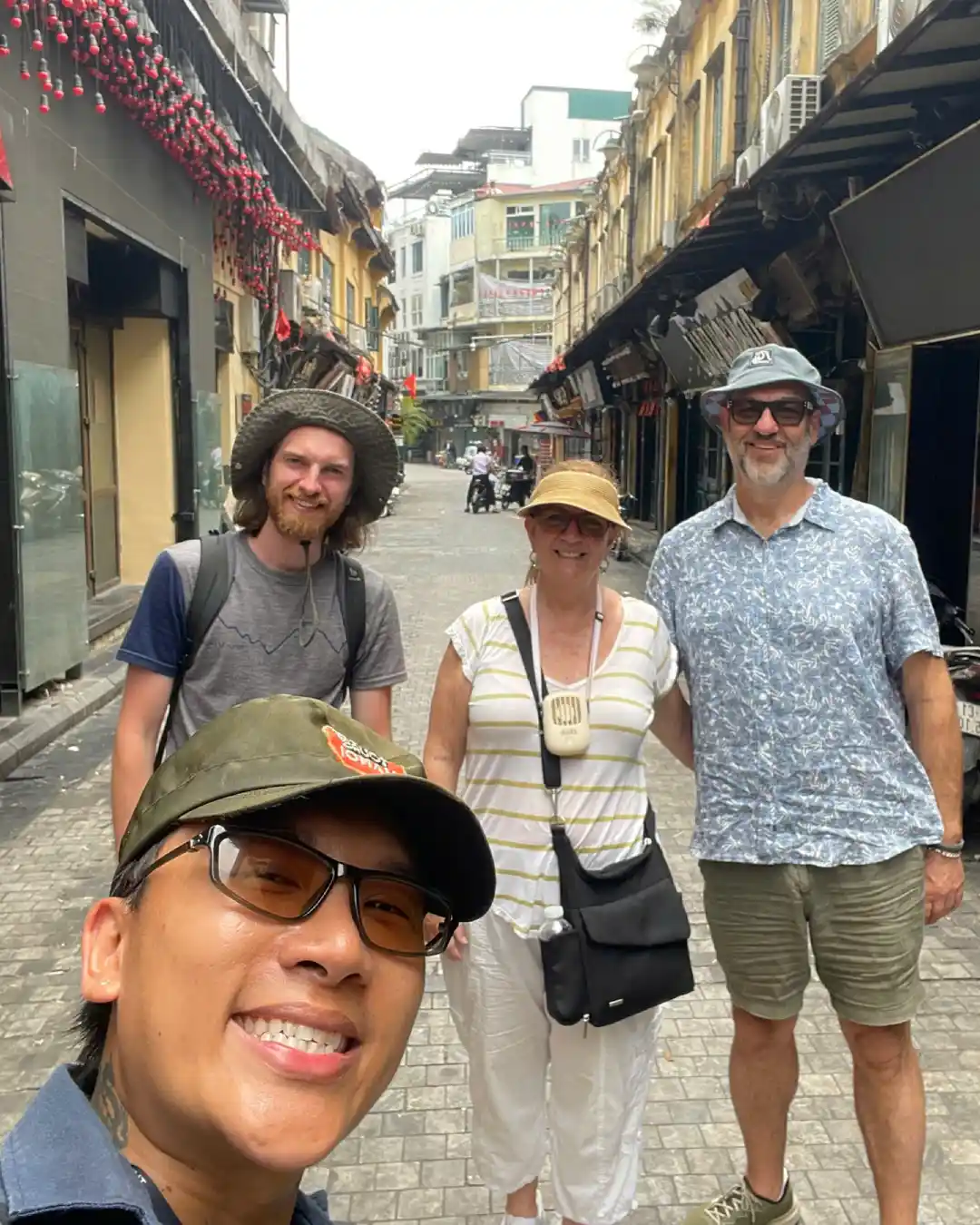
A photo journal from Hanoi — not a traveller review, and not proof that every detail in this guide happened on that walk.
Related content
Knowledge hub
Hanoi Landmarks →Historic landmarks, temples, markets and iconic places that define Hanoi.
Destination hub
Hanoi →Related stories
- Long Bien Bridge Guide: History, Walk & Local LifeWalk Hanoi's working Red River bridge — 1902 French-era steel, wartime scars, Bai Giua gardens and practical safety tips — with Old Quarter and Dong Xuan pairings.
- Bach Ma Temple Guide: Old Quarter's Guardian TempleVisit Bach Ma Temple in Hanoi's Old Quarter — White Horse legend, Hang Buom setting, respectful etiquette and how to weave it into a northern Old Quarter walking loop.
- Dong Xuan Market Guide: Hanoi's Historic Trading HubNavigate Dong Xuan Market like a local — wholesale floors, honest bargaining, nearby food, weekend night market and how to pair it with Long Bien and Old Quarter walks.
- The History of Thang Long and Modern Hanoi: A Thousand Years of ChangeDiscover the history of Hanoi from the founding of Thang Long in 1010 to the modern capital of Vietnam, including dynasties, colonial heritage and cultural landmarks.
- Hanoi Old Quarter Guide: Streets, Food & Walking LogicNavigate Hanoi's Old Quarter with local walking logic — guild streets, markets, food timing, night energy and how to pair the lake without turning the district into a checklist sprint.
- Complete Guide to Visiting Hanoi (2026)The ultimate 2026 cornerstone guide to Hanoi — how many days, top sights, neighbourhoods, food, transport, itineraries, safety, budget and day trips from local experts.