Hanoi Walking Tours: The Best Way to Understand the City
Why walking is the primary way to understand Hanoi — district logic, guided vs solo pacing, and how to structure foot-based days around Hoan Kiem and the Old Quarter.
By Shaw16 min readHanoi, Vietnam
Introduction — answer first
Search intent here is philosophical and practical at once: "Why do people keep saying I should walk Hanoi?" The honest answer: you cannot understand a city built for pedestrians by watching it through a tour-bus window. Thang Long grew as a citadel, lake city and merchant quarter long before motorbikes dominated every intersection. Temples, guild streets, colonial boulevards and residential hem (alleys) sit within a radius you can cover in a morning — if you accept uneven pavements, horn noise and the occasional wrong turn that becomes the best meal of your trip.
Shaw, our Hanoi heritage editor, tells every first-time guest the same thing: spend your first two hours on foot with someone who reads the street, then spend the next three days proving you were listening. Walking is not exercise here — it is the primary interface between visitor and city. The Old Quarter guide covers district detail; this page covers the logic of walking as your default transport mode.
Why Hanoi rewards walking more than almost any capital in Southeast Asia
A pre-car urban fabric still intact
Hanoi's historic districts were laid out for foot traffic, cyclos and short cart routes. The Old Quarter's 36 guild streets — Hang Bac for silver, Hang Gai for silk, Hang Ma for paper offerings — still function as commercial lanes barely wide enough for two motorbikes to pass. That scale means the interesting layer is always at eye level: shop-house facades, drying herbs, schoolchildren on break, a funeral incense trail leading to a communal house you would never notice from a car.
The French Quarter adds a different rhythm: tree-lined boulevards, opera house symmetry, villa gardens behind gates. Ba Dinh stretches the scale again — wide avenues, mausoleum protocol, temple compounds with formal entry paths. Walking connects these registers in a single day in a way no hop-on bus can replicate.
Density of meaning per square kilometre
Within roughly two kilometres of Hoan Kiem Lake you can traverse a thousand years of narrative: Ly dynasty temple foundations, Nguyen-era guild commerce, colonial administration, war-era resilience and contemporary startup cafés. Each block change is subtle until someone explains why the street name shifted, why that tree is sacred, why coffee is served with salt on this corner and condensed milk on the next.
Bus tours compress this into a photo stop. Walking lets you fail forward — miss a turn, find a courtyard, follow a smell, accept a stool invitation. Those unplanned sequences are what travellers remember, not the checklist of landmarks they photographed from a parking lot.
Sensory information buses filter out
Hanoi announces itself through sound and smell before sight: metal clatter from a machine shop, jackfruit sweetness at a market stall, fish sauce at dawn, the click of bamboo bird cages on a balcony. Motorbike exhaust and street food smoke mix in an olfactory signature that changes by hour and season.
Walking keeps those channels open. It also keeps you available — a nod from a shopkeeper, directions from a student practising English, a grandmother pointing you away from a flooded alley after rain. Those micro-interactions are the social fabric tour scripts cannot manufacture.
How walking unlocks the city — four layers
Layer 1: Navigation literacy
First-time visitors often feel the Old Quarter is a maze designed to confuse foreigners. It is — but it is a learnable maze. Guild streets run roughly parallel; lake orientation fixes north-south drift; odd-number addresses climb one direction. Two hours with a patient guide or a structured heritage walk converts panic into pattern recognition.
After that, getting lost becomes productive. You start recognising landmarks: O Quan Chuong gate, Dong Xuan market roofline, St Joseph's spire, the turtle tower silhouette on Hoan Kiem. Navigation literacy is the unlock — everything else follows.
Editorial tour pick for orientation: Hanoi heritage Old Quarter walking tour — guild streets, temple stops and alley etiquette in one coherent route.
Layer 2: Historical reading
Streets in Hanoi are archives. A walking pace lets you read them:
- Shop-house typology — narrow frontage, deep plan, courtyard light wells, mixed residential-commercial use
- Temple placement — community guardian deities at lane entrances, Buddhist pagodas on quieter blocks
- Colonial overlays — yellow stucco, green shutters, wrought iron, government buildings scaled to intimidate and impress
- Post-war adaptation — ground floors converted, upper floors extended, motorbike parking where courtyards once held trees
Heritage walks translate facades into stories. Without that translation, you see "old buildings." With it, you see economic history, religious practice and family continuity stacked in four metres of frontage.
Deep district context: Hanoi Old Quarter guide.
Layer 3: Daily life observation
Walking aligns you with Hanoi's daily clock:
| Time | What walkers see |
|---|---|
| 05:30–07:30 | Lake tai chi, market deliveries, pho shop prep, school convoys |
| 08:00–11:00 | Temple quiet, museum openings, café workers on break |
| 11:30–13:30 | Lunch rush, office workers on stools, heat building |
| 15:00–17:00 | Snack vendors, school release, golden light on yellow walls |
| 18:00–22:00 | Beer street energy, night market stalls, lake promenade couples |
| After 22:00 | Alley quiet, late coffee scholars, delivery bikes |
Bus tours often arrive at landmarks when locals are elsewhere. Walking lets you sync with the city rather than import your schedule onto it.
Layer 4: Food and coffee as wayfinding
Hanoi's street food geography is walkable by design. Bun cha alleys, banh mi corners, egg coffee addresses and fruit vendors cluster where foot traffic historically flowed. Following queues — politely, at a distance — is a legitimate navigation strategy.
Coffee culture deserves its own deep read, but walkers benefit immediately: a ca phe sua da pause resets heat and feet; a sidewalk stool is a classroom for watching intersection choreography. You do not need a food tour on day one if you walk with curiosity — though dedicated food walks accelerate learning for eager eaters.
Districts worth covering on foot — and how to sequence them
Hoan Kiem Lake ring — the orientation anchor
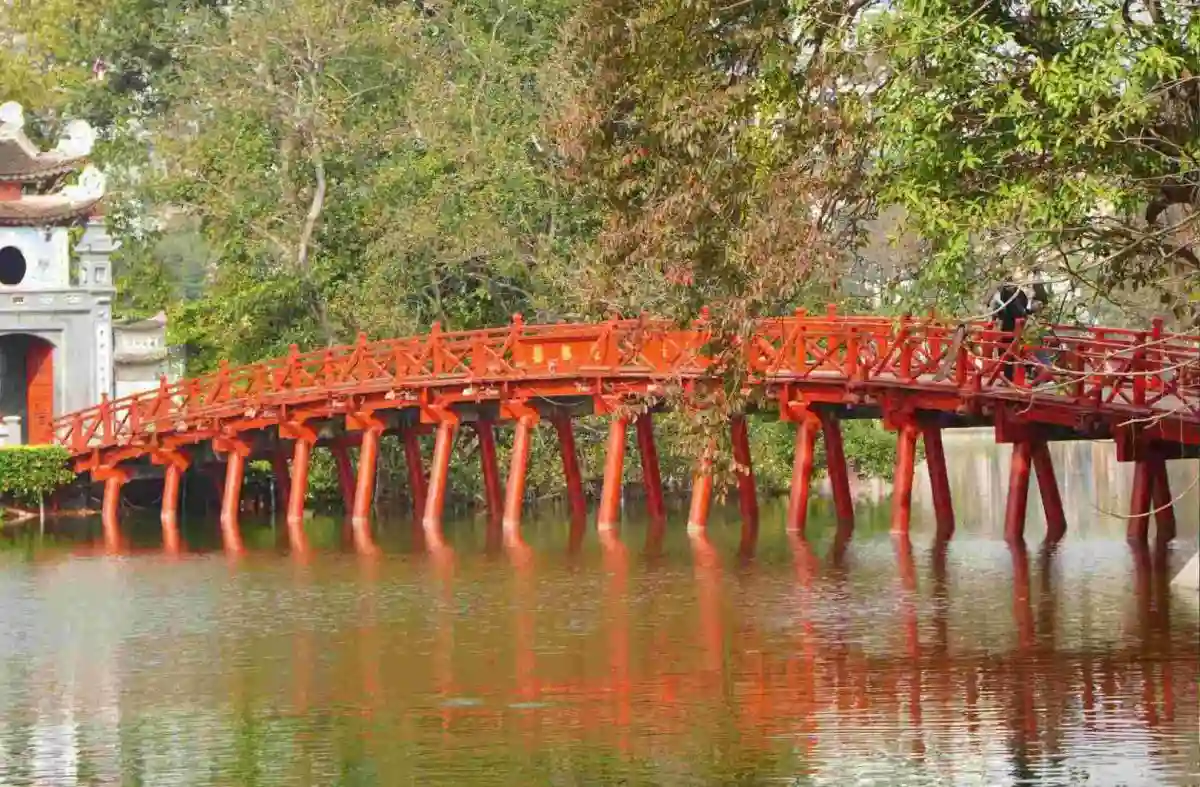
The lake is Hanoi's compass. A full circuit takes 45–60 minutes at stroll pace, longer if you enter Ngoc Son Temple or pause for photography. Morning belongs to exercise groups and photographers; evening to families and street performers on weekend pedestrian closures.
Use the lake as daily reset — start here day one, return after heavy museum days, end final night with circumambulation. Full lake detail: Hoan Kiem Lake Hanoi.
Old Quarter — guild streets and hem depth
Plan half a day minimum, not a rushed hour. Strategy: pick two guild streets for depth, one hem for exploration, one market for chaos tolerance. Dong Xuan market overwhelms in the best way; smaller lane markets near Hang Be feel more residential.
Do not attempt every "36 streets" in one walk — that is a lifetime project, not a Tuesday afternoon. The Old Quarter guide prioritises stops; walking logic says quality of attention beats quantity of names.
French Quarter — contrast and calm
South and east of the lake, boulevards widen, traffic eases slightly, cafés adopt indoor seating. Walk Trang Tien, Ly Thai To, Hai Ba Trung margins for colonial architecture without Old Quarter motorbike density. Pair with a sit-down coffee rather than continuous movement — this district rewards slow looking.
Ba Dinh — protocol and scale
The mausoleum, Ho Chi Minh stilt house, One Pillar Pagoda and Temple of Literature sit in a ceremonial walking zone with different rules: modest dress, quiet voice, timed entry for some sites. Allow a full morning; combine with taxi between distant gates if heat or mobility limits continuous walking. Ba Dinh is walkable in segments, not as a single wandering loop like the Old Quarter.
West Lake (Tay Ho) — optional extension
If your base moves to Tay Ho for a longer stay, lakeside walking replaces Hoan Kiem's intensity with sunset joggers, pagoda stops and expat café culture. It is not day-one essential for first-timers staying centrally — add when you want residential Hanoi rather than historic core density.
Walking tour types — what each unlocks (not where to buy)
Walking experiences cluster into categories. Understanding categories helps you choose once, wisely — then compare operators in the dedicated free vs paid walking tour guide.
| Tour type | Primary unlock | Best for |
|---|---|---|
| Heritage / Old Quarter | Navigation + history + temple etiquette | First 48 hours in Hanoi |
| City highlights | Cross-district sampler linking lake, quarter, French margins | Short stays, orientation |
| Street food walk | Menu literacy + hygiene confidence + vendor interaction | Eaters who want coaching |
| French Quarter / colonial | Architecture reading + café culture | Second visit or design interest |
| Hidden Hanoi / alley | Residential hem + community temples | Repeat visitors avoiding checklist |
| Private custom | Pace control + specific interests | Families, photographers, limited mobility variants |
Free walking tours (tip-based) lower financial risk for orientation but vary in group size and guide experience — covered honestly in the comparison guide, not here.
Editorial tour picks:
- Free tour of Hanoi — budget-friendly introduction when group dynamics suit you
- Hanoi city highlights walking tour — cross-district sampler in one coherent half-day
- Hanoi heritage Old Quarter walking tour — deepest guild-street focus for first-timers
Browse every current free departure on the Free Walking Tours hub.
Guided walk vs independent exploration — the recommended rhythm
Day 1–2: One guided foundation
Arrive, settle, walk with a guide once. Purpose is not entertainment — it is transfer of context: how to cross streets safely, how to read addresses, which temples welcome photos, where toilets and ATMs hide, how much to pay for water without getting tourist-priced.
Day 2–4: Independent recombination
Take the pattern your guide demonstrated and re-walk it alone at a different hour. Morning Old Quarter after an afternoon heritage tour reveals opposite energy. Return to a bun cha address you passed but did not enter. Sit at Hoan Kiem with a book and watch without agenda.
Day 4+: Thematic deep dives
By now you know your tolerance for heat, crowds and motorbike proximity. Add specialised walks — food, French Quarter, Ba Dinh protocol — or simply repeat favourite blocks until they feel familiar. Familiarity is underrated as a travel goal; Hanoi rewards return footfall.
When a second guided walk makes sense
Book again if your interests sharpen (photography light routes, architectural detail, war history focus) or if mobility needs adjust (shorter routes, more breaks, elevator-aware hotel return planning). Do not book five identical Old Quarter tours from different operators — that is checklist anxiety, not learning.
Practical walking logistics — shoes, safety, seasons
Footwear and physical honesty
Uneven tiles, surprise steps, wet markets and construction patches punish fashion shoes. Trainers with grip beat sandals; sandals beat heels. Blister plasters in your bag save an afternoon.
Assume 8,000–15,000 steps for a half-day heritage walk; full days with Ba Dinh or extended Old Quarter push higher. If knees or hips protest, plan taxi bridges between districts rather than heroic continuity.
Street crossing as learned skill
Hanoi traffic does not stop for pedestrians; it flows around them. Walk steadily, predictably, without sudden reversals. Follow locals when possible — their timing reads the wave pattern better than any app.
Guides teach crossing in the first ten minutes. Independent walkers should practise on a smaller street before attempting multi-lane chaos near Dong Xuan.
Weather and timing
October–November and March–April offer the most comfortable walking windows — detail in best time to visit Hanoi. Summer heat pushes walks to dawn and dusk; winter drizzle rewards waterproof shell and warm layer under humid air.
Rain does not cancel Hanoi — it changes it. Umbrella vendors appear instantly; coffee shops fill; alleys smell of wet brick. Walking in light rain is viable; thunderstorms pause outdoor legs.
What to carry
Water, sun protection, phone power bank, cash for spontaneous snacks, light scarf for temple modesty, offline map pin of your hotel in Vietnamese. Large backpacks annoy in crowded hem — day pack or crossbody.
Walking and the rest of your northern Vietnam itinerary
Walking Hanoi first calibrates expectations for everything north of the capital. Ninh Binh cycling, Sapa village paths, Ha Long deck pacing and Ha Giang roadside stops all assume you can manage hours on your feet. Skipping capital walking and jumping straight to a Ninh Binh day tour produces fatigue without context.
Sequence recommendation from planning your trip to Hanoi:
- Days 1–3: Walk-heavy Hanoi — lake, Old Quarter, one guided heritage route, Ba Dinh or French Quarter
- Day 4+: Regional trip with walking components — day trips from Hanoi for Ninh Binh, bay, mountains
The capital teaches how Vietnam moves at human speed. The provinces test that fitness at larger scale.
Local expert insights — what guides wish visitors understood
Slow down at the first temple, not the fifth. Guides watch guests photograph twelve stops without absorbing one. Bach Ma or Kim Ngan teaches more if you stay ten quiet minutes than if you collect fifteen facades.
Alleys are homes, not theme park backdrops. Hem walking is a privilege. Keep voice low, avoid blocking doorways, ask before photographing children or interior altars. A good guide models this; independent walkers must self-police.
The best food is often one block off the main guild street. Main arteries cater to predictable traffic; parallel lanes hold the bun cha queue locals actually join. Walking lets you detour; buses cannot.
Motorbike taxis save feet without ending the walk. Smart itineraries walk the core, Grab short hops between districts, walk again. Walking purism that ignores heat or mobility is not virtue — it is poor planning.
One great walk beats three mediocre ones. Shaw's team sees travellers book overlapping tours from different platforms, hear duplicate scripts, declare Hanoi " repetitive." One heritage foundation plus independent hours solves that.
Weekend lake pedestrianisation changes flow. Friday–Sunday evenings around Hoan Kiem close to bikes in zones — walking becomes celebration; navigation becomes crowd management. Enjoy it; adjust dinner reservations accordingly.
Common mistakes — walking edition
- Treating walking as something to "fit in" between bus tours — You miss the city’s default mode. Walk first; bus only for distance.
- Old Quarter once at midday in summer — Heat and motorbike density peak; dawn or late afternoon walks transform the experience.
- Wrong shoes on day one — Blisters cascade into cancelled days. Pack trainers before silk dresses.
- Photographing without pausing — Hanoi rewards standing still. The image without context is forgettable.
- Ignoring temple modesty — Shoulders and knees covered; hats off inside; no selfie sticks at active altars. Disrespect closes doors for everyone after you.
- Booking five similar tours instead of reading free vs paid comparison — Operator choice is a separate decision; duplicate content wastes money and time.
- Skipping Hanoi walks then expecting to "rest" on a Ninh Binh bike day — Cycling and boat boarding still demand mobility. Build fitness in the capital first.
- Walking with fixed dinner time across town — Old Quarter exploration runs long; traffic back to West Lake hotels punishes 19:00 reservations. Eat near where your feet end.
Sample walking-forward itineraries — Hanoi only
48 hours, first visit
| Day | Morning | Afternoon | Evening |
|---|---|---|---|
| 1 | Arrive, lake circumambulation | Guided heritage Old Quarter tour | Street food near hotel; early sleep |
| 2 | Independent Old Quarter revisit at dawn | French Quarter boulevard walk + coffee | Hoan Kiem sunset; optional Ta Hien people-watching |
4 nights, balanced depth
| Day | Focus |
|---|---|
| 1 | Lake + hotel neighbourhood orientation |
| 2 | Guided city highlights walk + Ngoc Son |
| 3 | Ba Dinh temples and mausoleum protocol (walk segments + taxi bridges) |
| 4 | Independent hem exploration OR second thematic walk; pack for day trip if day 5 |
Adjust for where you stay — Old Quarter bases reduce taxi need; Tay Ho bases add lake commute but quieter sleep.
Closing — walk first, book smart, return on foot
Hanoi does not reveal itself to passengers. It reveals itself to people willing to stand on uneven pavement, breathe exhaust and jackfruit together, accept wrong turns and learn one street name at a time. Walking is not the cheapest transport mode — time has value — but it is the most efficient teacher the city offers.
Do this: read the complete guide for the full capital picture; use planning checklist for booking sequence; compare operators in free vs paid walking tours; book one guided foundation walk; spend every remaining capital hour possible on foot.
You succeeded if Hanoi feels navigable on your last morning — if you buy coffee without GPS, if you cross Hang Bac without freezing, if an alley cat nap spot looks familiar. That familiarity is the souvenir no shop sells.
Read next: Old Quarter guide · Hoan Kiem Lake · free vs paid walking tours · day trips from Hanoi
Local tips
- →Eat the signature dish for Hanoi Walking Tours when the stall is busy with locals — turnover beats décor.
- →Hanoi Walking Tours: For Hanoi food crawls, start hungry but not starving; pace stops 20–30 minutes apart.
- →Group Hanoi Walking Tours with nearby sights in the same Hanoi district to cut cross-town Grab time.
- →Walk to Hanoi Walking Tours early; Hanoi heat and scooter density rise after 09:30.
Good to know
- This page covers walking logic — operator buying guide is separate.
- Ba Dinh monuments need a half-day walk or vehicle leg — not a lake loop add-on.
- Pavements are uneven; mobility needs may favour shorter routes.
- Grab works for tired legs home — walking days can still end with a short ride.
Before you go
- Carry small VND notes for Hanoi Walking Tours; many excellent stalls remain cash-first.
- Hanoi Walking Tours: If travelling with allergies, learn key ingredient words before you order around Hanoi.
- Screenshot offline maps for the blocks around Hanoi Walking Tours before you enter dense Hanoi lanes.
Common mistakes
- ✕Trying to see Hanoi only from a tour-bus window.
- ✕Skipping a guided intro and struggling with alley navigation on day one.
- ✕Walking midday in summer without water or shade breaks.
- ✕Treating walking tours and food tours as the same product.
Practical information
- How to get there
- Stay in Old Quarter or French Quarter for walkable access. Most guided walks meet near Hoan Kiem Lake or Old Quarter hotels.
- Best time to visit
- October–November and March–April for comfortable walking weather. Dawn for lake; late afternoon for Old Quarter atmosphere.
- Suggested itinerary
- Guided heritage walk day 1 → independent Old Quarter and French Quarter day 2 → Ba Dinh walk or coach day 3.
- Nearby attractions
- Hoan Kiem Lake
- Hanoi Old Quarter
- French Quarter
- Long Bien Bridge
Frequently asked questions
- Are walking tours suitable for first-time visitors?
- Yes. Walking tours provide an excellent introduction to Hanoi and help visitors become familiar with the city’s layout and culture.
- How long do walking tours usually last?
- Most walking tours last between two and four hours.
- Is Hanoi easy to explore on foot?
- The central districts are highly walkable, although visitors should be prepared for busy traffic and uneven pavements.
- What should I bring?
- Comfortable shoes, water, sun protection, and a camera are recommended.
- Why choose a walking tour instead of a bus tour?
- Walking provides a closer connection to local life, allows access to hidden areas, and creates opportunities for deeper cultural understanding.
From the road
Related real moment
A photo journal from Hanoi — not a traveller review, and not proof that every detail in this guide happened on that walk.

Related content
Destination hub
Hanoi →Related stories
- Free vs Paid Hanoi Walking Tours: Which to BookCompare free tip-based and paid Hanoi walking tours — group size, tip norms, route depth and when each format wins — so you book the walk that matches your day, not just the lowest sticker price.
- Hanoi Street Food Culture: Eating Like a LocalEat Hanoi with local timing and judgement — stall heuristics, meal windows, hygiene sense and funnels into pho, bun cha, banh mi and guided food walks.
- Hanoi Egg Coffee Guide: From Sidewalk Cafés to Egg CoffeeUnderstand Hanoi coffee culture — sidewalk stools, robusta drip, egg coffee history, and how to taste like a local without treating every café as a tourist stop.
- Complete Guide to Visiting Hanoi (2026)The ultimate 2026 cornerstone guide to Hanoi — how many days, top sights, neighbourhoods, food, transport, itineraries, safety, budget and day trips from local experts.
- Hanoi Old Quarter Guide: Streets, Food & Walking LogicNavigate Hanoi's Old Quarter with local walking logic — guild streets, markets, food timing, night energy and how to pair the lake without turning the district into a checklist sprint.
- Things to See in Hanoi: A First-Time Visitor's GuideA ranked shortlist of 15 essential Hanoi sights for first-time visitors — grouped by district with links to deep guides for tickets, timing and dress codes.