Responsible Tourism in Northern Vietnam: Ethics for Treks & Cruises
Travel northern Vietnam responsibly — homestay etiquette, photo consent, market behaviour, wildlife caution and how to choose ethical trekking and cruise operators.
By Paul15 min readNorthern Vietnam
Introduction — answer first
Travellers ask: "How do I travel ethically in northern Vietnam?" Book licensed homestays and fair-pay treks, ask before photographing Hmong, Dao, and Tay community members, pay stated village fees to operators who disclose them, buy crafts directly from makers when possible, and refuse tours that parade children or costume renters as unpaid attractions. Northern Vietnam's highlands are living communities, not open-air museums — your spending and behaviour either support household income or accelerate extractive tourism.
This page is responsible tourism editorial for the north — Sapa, Ha Giang, Pu Luong, and market towns — distinct from general politeness in Vietnamese etiquette for travelers. Depth on specific groups lives in Sapa ethnic minorities guide; market behaviour in Ha Giang markets guide; sleep choices in Sapa homestay guide and Pu Luong homestay guide.
Paul's line: Ethical travel here is mostly procurement — who gets your dong, and whether you asked permission before the shutter clicked.
Why northern Vietnam needs explicit ethics
The north combines poverty-region tourism growth, distinct ethnic minority cultures, and Instagram demand for "colorful tribe" imagery. Without guardrails, outcomes include:
| Harm pattern | Example |
|---|---|
| Commodified children | Following trekkers selling bracelets for hours |
| Fake homestays | Concrete guesthouses with "village" signage |
| Photo extraction | Portraits posted without consent or compensation |
| Land pressure | Unlicensed campsites, litter at sacred viewpoints |
| Cultural flattening | One "minority show" replacing diverse identities |
Shaw: Sapa overtourism taught the region what not to repeat — Ha Giang and Pu Luong still have windows to do better.
Reading Sapa ethnic minorities guide before any highland trip contextualises names, clothing, and history — ethics starts with literacy.
Core principles — five rules
1. People before photos
Ask permission before photographing faces — gesture, smile, show camera. No means no without debate. At Ha Giang markets, buy something small if you spent time at a stall photographing craft — relationship, not transaction law, but courtesy matters.
Children: Do not pay children for photos — incentivises skipping school. Buy from adult vendor if purchasing craft.
2. Pay fairly for labour
Guides, homestay hosts, and drivers are skilled workers. Bargain souvenirs gently if culture allows — not guide day rates after service.
Tours disclosing village fee portions beat mystery cheap day trips. Compare Sapa trekking tour transparent operators vs kerbside "cheap trek" touts.
3. Sleep in real homes (licensed)
Sapa homestay guide and Pu Luong homestay guide distinguish family mat-sleeping, shared meals from hotel blocks labelled homestay. Ask: Who eats with us? Where does fee go?
Dinh: If thirty buses park outside, it is not a homestay — it is a staging area.
4. Leave no trace on trails
Rice terraces, Ma Pi Leng viewpoints, and jungle paths lack municipal cleanup. Carry out all plastic. Do not pick crops — terrace walk permission comes through guide and host, not assumption.
Pu Luong tour operators increasingly enforce pack-in-pack-out — choose those stating policy.
5. Respect ritual and festival space
Vietnamese festival calendar lists highland events — some closed to outsiders or photography restricted. Observe from distance; confirm with local authority or guide. Dress modestly at communal house events.
Anna: Festival is worship, not content day — unless invited, stay peripheral.
Homestays — ethical booking checklist
Before paying deposit:
| Question | Good answer |
|---|---|
| Who owns the house? | Named family on operator site or review |
| Meals included? | Shared table with hosts when possible |
| Sleeping layout? | Private room or shared dorm — your comfort choice stated |
| Village fee? | Portion to community fund disclosed |
| Group size cap? | Small groups — not forty-bed dorm blocks |
| Child policy? | No school-age hosts performing instead of studying |
Cross-read Sapa homestay guide for Red Dao and Hmong specifics; Pu Luong homestay guide for Thai ethnic community tourism in rice-valley settings.
Paul: One night minimum homestay — day-trip "village visits" rarely benefit households.
Trekking and motorbike loops — guide ethics
Sapa trekking
Licensed guides know trail erosion, seasonal closures, and village entry norms. Unlicensed followers harm trail sustainability and undercut community guides.
Book Sapa trekking tour 2 days 1 night or equivalent with stated guide licensing — confirm locally if regulations updated.
Pace: Do not treat porters or elderly hosts as props in fitness content.
Ha Giang easy rider loops
Ha Giang loop planning guide covers logistics — ethics add:
- Licensed drivers with rested schedules — not 16-hour adrenaline runs
- Homestay nights in Dong Van, Meo Vac — money stays upland
- Market mornings — Ha Giang markets guide photo rules
Ha Giang easy rider 3 days should disclose accommodation type — verify homestay vs hotel before booking.
Pu Luong valley
Lower overtourism than Sapa — window to model better:
- Pu Luong homestay guide — Thai community weaving and rice work
- Pu Luong tour 3 days 2 nights — multi-night reduces dash-and-flash
Shaw: Pu Luong rewards slow — ethical alignment and experience quality match.
Markets — shopping and photography
Ha Giang markets guide is the behavioural companion to this page.
| Do | Don't |
|---|---|
| Greet vendor before close-up photo | Long-lens sneak shots |
| Buy if you blocked stall traffic | Haggle to insult on hand embroidery |
| Learn one Hmong or Dao greeting | Shout English expecting service |
| Put phone away during payment | Film card PIN or counting cash |
Sapa ethnic minorities guide explains clothing significance — not costume for your feed.
Craft buying — support makers
Direct purchase from maker or cooperative beats airport mass souvenir:
- Ask who woven / carved — middleman markup visible in same-item price spread
- Pay fair for labour hours — embroidery takes days
- Avoid "orphan craft" stories unless verified — scam narrative common
- Ship legally — customs labels honest
Ethical buying does not require overpaying — it requires not demanding artisan prices at factory rates.
Overtourism pockets — where to tread lightly
| Area | Pressure | Ethical response |
|---|---|---|
| Sapa town centre | Crowds, costume renters | Trek outward; overnight village |
| Cat Cat village (Sapa) | Bus volume | Skip or short off-peak visit — confirm locally |
| Trang An / Tam Coc | Boat queues | Shoulder season; licensed operators |
| Ha Giang loop viewpoints | Litter peaks | Pack out; avoid drone noise near homes |
This page focuses highland community tourism — karst boat ethics overlap Ninh Binh guides separately.
Children, schools, and donations
Do not:
- Give candy or money to children who follow treks
- Enter schoolyards uninvited for photos
- Volunteer day-care without vetted organisation — orphanage tourism risks
Do:
- Support community funds through licensed operators
- Donate to verified local NGOs if moved — research independently
- Buy adult-made crafts
Anna: Visible poverty is not invitation — etiquette guide dignity baseline.
Festivals and sacred sites
Vietnamese festival calendar — highland events include love markets, harvest rituals, new rice ceremonies.
Rules:
- Confirm visitor welcome — some events closed
- Modest dress — shoulders, knees covered
- No flash in dim ritual halls
- Follow guide or elder direction on seating and photography
- Leave offering if community requests — small, appropriate
Paul: If you would not behave this way in a church at home, do not at a communal house.
Language, learning, and cultural respect
Ethical travel includes minimal language effort — not fluency, but greeting and thanks in local tongues:
| Phrase purpose | Why it matters |
|---|---|
| Xin chào (hello) | Baseline Vietnamese respect — etiquette guide |
| Cảm ơn (thank you) | After homestay meal or market purchase |
| One Hmong/Dao greeting learned from guide | Shows Sapa ethnic minorities context absorbed |
Anna: Guide teaches pronunciation — repeat badly with smile beats silent extraction.
Avoid: Demanding English in remote market; mocking dress pronunciation; correcting elders' Vietnamese for sport.
Reading before travel: Sapa ethnic minorities guide, Ha Giang markets guide, Pu Luong homestay guide — names and clan structure prevent "colorful tribe" flattening.
Wildlife, drones, and noise
Highland ethics extend to non-human environment:
- No drone over villages without permission — noise disrupts livestock and privacy
- Bird and butterfly photography — stay on trail — terrace edge collapse hurts farmers per Pu Luong rice terraces context
- Campfires — only where host permits — fire risk dry season
Shaw: Ma Pi Leng viewpoint litter correlates with convoy stops — choose operators limiting vehicle count on Ha Giang loop.
Environmental responsibility
Northern trails cross watersheds and terrace agriculture:
- Stick to marked paths — terrace edge collapse hurts farmers
- No soap in streams — biodegradable claims still disrupt
- Refill bottles where safe — confirm water source with host
- Minimise motorbike exhaust — share rides on Ha Giang loop when safe
Climate impact: Train to Lao Cai beats private car only — see train vs sleeper bus for mode ethics and emissions framing.
Choosing ethical tours — red and green flags
Green flags
- Named guide profiles and licensing mention
- Maximum group size stated (e.g. 8–12 trek)
- Homestay family named in itinerary
- Village or conservation fee line item
- Reviews mentioning meals with hosts, not only viewpoints
Red flags
- "Free" trek with mandatory shopping stops
- No guide — self-ride Ha Giang without local support on first visit
- Animal exploitation — unregulated elephant or bear venues (rare north but watch south transfer marketing)
- Infinite costume photo stops without cultural explanation
- Reviews citing school-age sellers following all day
Book examples with disclosure culture: Sapa trekking tour, Ha Giang easy rider, Pu Luong tour — still verify operator locally; standards shift.
Post-trip feedback — closing the loop
Responsible travel does not end at the airport. Your review currency shapes operator behaviour:
| Action | Impact |
|---|---|
| Name guide and homestay host positively | Rewards fair operators — Sapa homestay guide booking channels |
| Flag forced shopping in reviews | Warns next travellers — market pressure on agencies |
| Share specific village names helped | Directs income to communities readers can request |
| Avoid vague "authentic" praise | Vague praise props photo-stop tours |
Paul: One detailed ethical review beats ten Instagram reels for community benefit.
If something crossed a line — child following all day, undisclosed shopping stop — email operator and platform. Vietnamese tourism standards improve with foreign complaint volume — polite, specific, factual.
Dinh: Tip guides in cash hand-to-hand when deserved — app tips sometimes skip local partner.
Northern Vietnam route ethics — quick map
| Route | Primary ethical focus | Depth guide |
|---|---|---|
| Sapa trek | Homestay authenticity, child sellers | Sapa ethnic minorities, Sapa homestay |
| Ha Giang loop | Driver rest, market consent, litter | Ha Giang loop planning, Ha Giang markets |
| Pu Luong | Terrace path respect, Thai community income | Pu Luong homestay, rice terraces |
| Ninh Binh (add-on) | Boat queue patience, licensed operators | Ninh Binh guide |
| Transport mode | Train vs bus community impact | Train vs sleeper bus |
Shaw: Ethics route map — read relevant row before booking, not all five if your trip is Sapa-only.
Anna adds festival timing: Vietnamese festival calendar — some events welcome guests; others closed — ethical choice is not attending when unwelcome.
Closing — travel that leaves value behind
Responsible tourism in northern Vietnam is not austerity — it is clarity: know who hosts you, pay for labour honestly, ask before portraits, carry your trash, and choose multi-night community stays over drive-by ethnicity. The highlands reward travellers who slow down and read context in Sapa, Ha Giang markets, and Pu Luong homestays before the shutter opens.
Read next: Sapa ethnic minorities guide · Vietnamese etiquette for travelers · Ha Giang loop planning guide · Sapa homestay guide · Pu Luong homestay guide
Book: Sapa trekking tour 2 days 1 night · Ha Giang easy rider 3 days · Pu Luong tour 3 days 2 nights from Hanoi
FAQ — quick answers
Question: What is responsible tourism in Vietnam?
Answer: Travel choices that benefit local communities and minimise harm — fair-pay guides and homestays, photo consent, litter carry-out, and refusing exploitative tours. In the north, read Sapa ethnic minorities guide and this page together.
Question: Is Sapa tourism ethical?
Answer: It can be — if you trek with licensed guides, stay in real homestays, and avoid commodified child sellers. Overtourism pockets exist — Sapa homestay guide helps choose better.
Question: Can I photograph people at Ha Giang markets?
Answer: Ask first — greet, gesture to camera, respect refusal. See Ha Giang markets guide. Buy from vendors if you spent time at their stall.
Question: How do I choose an ethical homestay?
Answer: Named family, shared meals, small groups, disclosed village fees — Sapa homestay guide and Pu Luong homestay guide checklists.
Question: Are Ha Giang easy rider tours ethical?
Answer: Depends on operator — licensed rested drivers, homestay nights, fair driver pay. Ha Giang easy rider 3 days plus Ha Giang loop planning guide — verify accommodation type before booking.
Question: Should I give money to children on trails?
Answer: No — do not pay children for photos or buy from persistent child followers. Purchase adult-made crafts; support community funds through operators.
Question: What should I avoid in northern Vietnam?
Answer: Free treks with forced shopping, fake homestays with bus parking only, sneaky photography, litter on terraces, and intrusion at festivals — Vietnamese festival calendar for timing.
Question: Which tours support responsible travel?
Answer: Multi-night treks with named guides and homestays — e.g. Sapa trekking tour, Pu Luong tour. Confirm policies locally; standards vary by operator.
Local tips
- →Use Responsible Tourism in Northern Vietnam to freeze trip shape before you buy non-refundable long-transfer tickets.
- →Build one empty half-day into any plan derived from Responsible Tourism in Northern Vietnam — Hanoi weather and traffic punish rigidity.
- →Group Responsible Tourism in Northern Vietnam with nearby sights in the same Hanoi district to cut cross-town Grab time.
- →Walk to Responsible Tourism in Northern Vietnam early; Hanoi heat and scooter density rise after 09:30.
Good to know
- Responsible Tourism in Northern Vietnam assumes typical 2026 transfer times — festivals and storms add buffer needs.
- Responsible Tourism in Northern Vietnam: Family, solo and accessible variants of Hanoi travel change the same skeleton plan.
- Near Responsible Tourism in Northern Vietnam, Hanoi street vendors often need small cash even when hotels take cards.
- Tet and festival weeks change opening patterns for Responsible Tourism in Northern Vietnam — verify that week’s hours.
Before you go
- Before you go: save offline copies of Responsible Tourism in Northern Vietnam and key vouchers.
- Tell travelling companions the “must keep” days from Responsible Tourism in Northern Vietnam versus optional swaps.
- Screenshot offline maps for the blocks around Responsible Tourism in Northern Vietnam before you enter dense Hanoi lanes.
Common mistakes
- ✕Treating ethnic dress as photo prop — Read Sapa ethnic minorities guide first.
- ✕Booking cheapest "village tour" — Shopping stops exploit time; hosts see little.
- ✕Photographing children without parent OK — Incentivises street following.
- ✕One-hour "homestay visit" — Performance without overnight income — homestay guides .
- ✕Ignoring market etiquette — Ha Giang markets guide exists for reason.
- ✕Ha Giang loop speed-run — Exhausted drivers, litter stops skipped — planning guide .
- ✕Assuming etiquette equals ethics — Vietnamese etiquette polite; ethics adds fair pay and consent.
- ✕Festival crowd intrusion — Vietnamese festival calendar — observe boundaries.
Practical information
- How to get there
- See Getting there / planning sections in the article body.
- Best time to visit
- Follow seasonal and daily timing advice in the Quick Facts and body.
- Suggested itinerary
- Use the itinerary and pairing sections in the article, then book related tours if logistics are heavy.
- Nearby attractions
- Related destination hubs
- Hanoi planning Stories
- Northern Vietnam itinerary
Frequently asked questions
- What is responsible tourism in Vietnam?
- Travel choices that benefit local communities and minimise harm — fair-pay guides and homestays, photo consent, litter carry-out, and refusing exploitative tours. In the north, read Sapa ethnic minorities guide and this page together.
- Is Sapa tourism ethical?
- It can be — if you trek with licensed guides, stay in real homestays, and avoid commodified child sellers. Overtourism pockets exist — Sapa homestay guide helps choose better.
- Can I photograph people at Ha Giang markets?
- Ask first — greet, gesture to camera, respect refusal. See Ha Giang markets guide. Buy from vendors if you spent time at their stall.
- How do I choose an ethical homestay?
- Named family, shared meals, small groups, disclosed village fees — Sapa homestay guide and Pu Luong homestay guide checklists.
- Are Ha Giang easy rider tours ethical?
- Depends on operator — licensed rested drivers, homestay nights, fair driver pay. Ha Giang easy rider 3 days plus Ha Giang loop planning guide — verify accommodation type before booking.
- Should I give money to children on trails?
- No — do not pay children for photos or buy from persistent child followers. Purchase adult-made crafts; support community funds through operators.
- What should I avoid in northern Vietnam?
- Free treks with forced shopping, fake homestays with bus parking only, sneaky photography, litter on terraces, and intrusion at festivals — Vietnamese festival calendar for timing.
- Which tours support responsible travel?
- Multi-night treks with named guides and homestays — e.g. Sapa trekking tour, Pu Luong tour. Confirm policies locally; standards vary by operator.
From the road
Related real moment
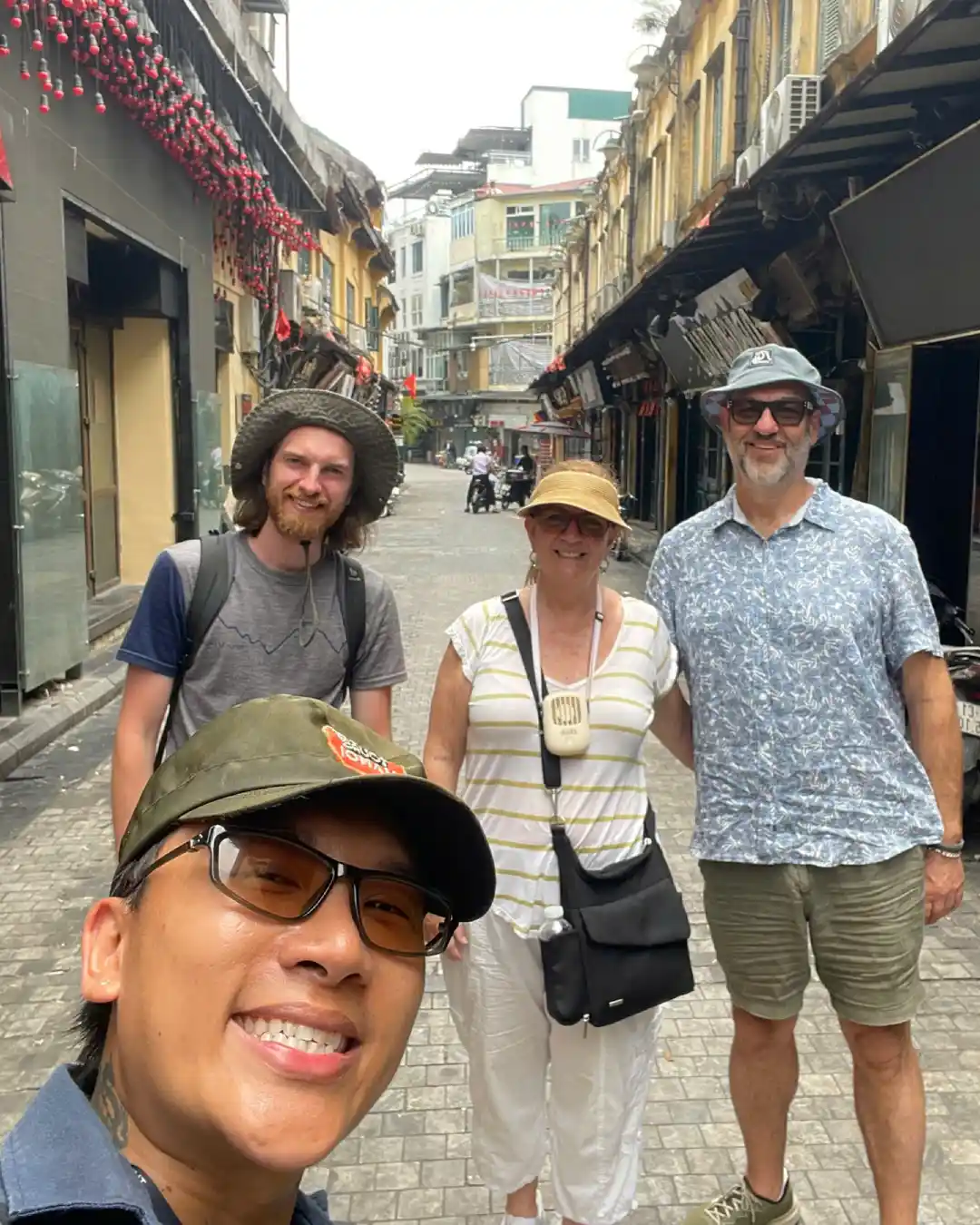
A photo journal from Hanoi — not a traveller review, and not proof that every detail in this guide happened on that walk.
Related content
Destination hub
Hanoi →Related stories
- Vietnamese Etiquette for Travelers: Temples, Dining & PhotosTravel Vietnam with respectful habits — temple dress, dining manners, photography consent, tipping norms and how etiquette changes between Old Quarter streets and sacred sites.
- Ba Vi National Park Guide: Trails, Summit & Day TripVisit Ba Vi National Park — summit trails, forest air, temple ridge and honest day-trip timing from Hanoi.
- Vietnamese Festival Calendar: Hanoi & Northern HighlightsPlan around Vietnam's festival calendar — Tet, Mid-Autumn, temple festivals and highland market peaks — with Hanoi pacing and northern trip timing cues.
- Sapa Homestay Guide: What to Expect, Etiquette & BookingBook a Sapa homestay with clear expectations — bedding, bathrooms, meals, etiquette and how overnight trekking packages differ from town hotels.
- Pu Luong Homestay Guide: Stilt Houses, Meals & EtiquetteStay in a Pu Luong homestay — stilt-house comfort levels, meals, bathrooms, etiquette and how organised treks from Hanoi package overnight village stays.
- Ha Giang Loop Planning Guide: 2, 3 or 4 Days from HanoiPlan the Ha Giang Loop from Hanoi — 2/3/4-day pacing, easy rider vs self-drive honesty, seasonal roads and how to book without brochure confusion.